
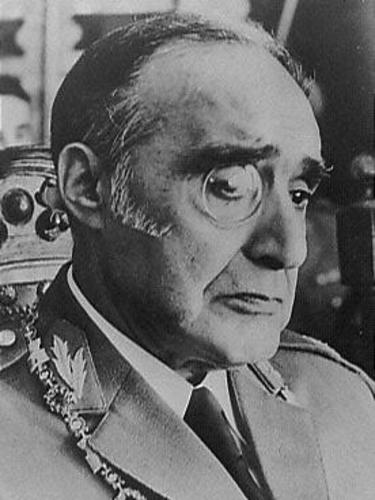
António de Spínola
António de Spínola was a President of Portugal. Born April 11, 1910, in Estremoz. Died August 13, 1996, in Lisbon. Positions held include President of Portugal (1974). Educated at Portuguese Military Academy and Colégio Militar. Awards include Commander of the Military Order of Avis, Grand Cross of the Sash of the Three Orders and Grand Officer of the Military Order of the Tower and Sword.
Facts
28 facts · 2 confirmed by two sources · 8 cited · 18 from one source
Where this comes from
Papalocal keeps its own record. It started from these sources; what each one said is kept here as it was copied, so a change on their side never changes this page by itself. Tap one to read its version.
What Wikidata says · copied November 16, 2026 · revision 2559700062
- Described as
- President of Portugal (1974)
- Other names
- Antonio de Spinola, António Sebastião Ribeiro de Spínola
- Born
- April 11, 1910 · 6 references
- Died
- August 13, 1996 · 6 references
- Born in
- Estremoz · 1 reference
- Died in
- Lisbon · 1 reference
- Buried in
- Lisbon
- Cause of death
- pulmonary embolism
- Citizen of
- Portugal
- Occupation
- politician · 1 reference; military officer; writer · 1 reference; revolutionary
- Positions held
- President of Portugal (1974)
- Political party
- Democratic Movement for the Liberation of Portugal
- Education
- Portuguese Military Academy; Colégio Militar
- Awards
- Commander of the Military Order of Avis (1959) · 1 reference; Grand Cross of the Sash of the Three Orders; Grand Officer of the Military Order of the Tower and Sword (1973) · 1 reference; Officer of the Military Order of Avis (1948) · 1 reference; Grand Cross of the Military Order of the Tower and Sword (1987) · 1 reference; Grand Cross of the Order of Isabella the Catholic (1987) · 1 reference; Blue Division Medal; Medalla de la Campaña de Rusia
- Spouse
- Maria Helena Spínola
- Father
- António Sebastião Spínola · 1 reference
- Religion
- Catholic Church
- Military branch
- Portuguese Army · 1 reference
- Military rank
- general · 1 reference
- Wikipedias with a page
- 39
Wikidata item Q336884 (wikidata.org/wiki/Q336884), public domain (CC0). Copied November 16, 2026.
What Wikipedia says · copied November 16, 2026 · revision 1378238265
António Sebastião Ribeiro de Spínola (Portuguese pronunciation: [ɐ̃ ˈtɔniu ðɨ ˈspinulɐ]; 11 April 1910 – 13 August 1996) was a Portuguese military officer, author and conservative politician. During the Estado Novo regime he became one of Portugal's most senior military commanders, leading military operations against independence movements. After the Carnation Revolution, partially organised by under-ranked military captains, he was invited to be the president of Portugal. His role in Portugal's transition to democracy remains highly controversial, particularly regarding his role in leading the 11 March 1975 attempted coup as well as the anticommunist terrorist organisation Movimento Democrático de Libertação de Portugal (Democratic Movement for the Liberation of Portugal). He was noted for wearing a monocle on his right eye.
- Born, in its opening lines
- April 11, 1910
- Died, in its opening lines
- August 13, 1996
From the Wikipedia article “António de Spínola” (en.wikipedia.org/wiki/António_de_Spínola), by its contributors, under CC BY-SA 4.0 (creativecommons.org/licenses/by-sa/4.0/). Copied November 16, 2026; not changed.
Confirmed Two sources agree. Cited One source, and it names where it got it. One source One source, without a reference of its own. Sources disagree The sources disagree. We show the best-supported value and keep theirs below.
