
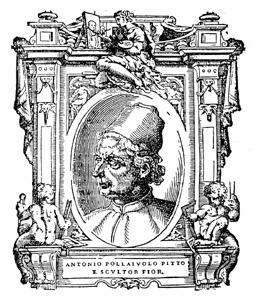
Antonio del Pollaiuolo
Antonio del Pollaiuolo was an Italian painter, sculptor and engraver. Born 1431, in Florence. Died February 4, 1498, in Rome. Known for Apollo and Daphne, Elevation of the Magdalen and Capitoline Wolf.
Facts
23 facts · 1 confirmed by two sources · 9 cited · 12 from one source · 1 where the sources disagree
What’s different
- Born: we show 1431 (Sources disagree). Wikipedia says January 17, 1429
Where this comes from
Papalocal keeps its own record. It started from these sources; what each one said is kept here as it was copied, so a change on their side never changes this page by itself. Tap one to read its version.
What Wikidata says · copied November 16, 2026 · revision 2570467402
- Described as
- Italian painter, sculptor and engraver (1429-1498)
- Other names
- Antonio Pollaiuolo, Antonio di Jacopo d'Antonio Benci del Pollagiolo, Antonio Di Jacopo D'Antonio Benci Del Pollaiuolo, Antonio di Jacopo d'Antonio Benci del Pollaiuolo, Antonio Di Jacopo D'Antonio Benci Del Pollagiolo, Antonio del Polaiolo, Antonio Pallajuolo, Antonio Del Pollaiolo, Antonio Pollagiolo, Antonio Pollajuolo, Antonio di Jacopo d'Antonio Benci del Pollajuolo, Pollaiuolo
- Born
- 1431 · 1 reference
- Died
- February 4, 1498 · 2 references
- Born in
- Florence · 1 reference
- Died in
- Rome · 2 references
- Buried in
- San Pietro in Vincoli
- Citizen of
- Republic of Florence
- Occupation
- painter · 2 references; sculptor · 1 reference; engraver; graphic artist; architect · 1 reference; draftsperson · 1 reference; goldsmith · 1 reference; medalist · 1 reference
- Known for
- Apollo and Daphne; Elevation of the Magdalen; Capitoline Wolf; Battle of the Nudes; Sixtus IV tomb · 1 reference
- Field
- art of sculpture · 1 reference; painting; graphics
- Siblings
- Piero del Pollaiuolo · 1 reference
- Wikipedias with a page
- 39
Wikidata item Q318640 (wikidata.org/wiki/Q318640), public domain (CC0). Copied November 16, 2026.
What Wikipedia says · copied November 16, 2026 · revision 1380085846
Antonio del Pollaiuolo (UK: POL-eye-WOH-loh, US: POHL-, Italian: [anˈtɔːnjo del pollaˈjwɔːlo]; 17 January 1429/1433 – 4 February 1498), also known as Antonio di Jacopo Pollaiuolo or Antonio Pollaiuolo (also spelled Pollaiolo), was an Italian Renaissance painter, sculptor, engraver, and goldsmith, who made important works in all these media, as well as designing works in others, for example vestments, metal embroidery being a medium he worked in at the start of his career.
His most characteristic works in his main media show largely naked male figures in complicated poses of violent action, drawing from classical examples and often centred on a heroic Hercules. He, or possibly his brother, was also an innovative painter of wide landscape backgrounds, perhaps having learnt from Early Netherlandish painting. His two papal tombs were the only monuments to survive the demolition of Old St Peter's in the next century and be reconstructed in the present St Peter's Basilica.
He very often worked in collaboration with his younger brother Piero del Pollaiuolo (c. 1443–1496), and distinguishing their contributions to satisfy modern ideas of authorship has proved exceptionally difficult, so that many paintings are just described as by the Pollaiuolo brothers. Contemporaries, and Giorgio Vasari, saw Antonio as by far the more talented, and responsible for the design and main painting of most works, but in recent decades the reputation of Piero has strengthened somewhat, and he is now given sole authorship of, for example, the small Apollo and Daphne (1470–1480) by its owner, the National Gallery. At the same time, contemporary references in lists of leading artists, of which there are a number, mostly mention the brothers together, and Vasari's Lives of the Artists treats them in a single life.
According to Kenneth Clark, two factors have reduced his prominence in the modern view of Quattrocento art: the loss of his large paintings of the labours of Hercules (surviving only in miniature copies), and "a name which looks difficult to pronounce". In his own day, and for several decades later, his "true position" as "one of the originating forces in the history of European art" was recognised.
- Born, in its opening lines
- January 17, 1429
- Died, in its opening lines
- February 4, 1498
From the Wikipedia article “Antonio del Pollaiuolo” (en.wikipedia.org/wiki/Antonio_del_Pollaiuolo), by its contributors, under CC BY-SA 4.0 (creativecommons.org/licenses/by-sa/4.0/). Copied November 16, 2026; not changed.
Confirmed Two sources agree. Cited One source, and it names where it got it. One source One source, without a reference of its own. Sources disagree The sources disagree. We show the best-supported value and keep theirs below.
