
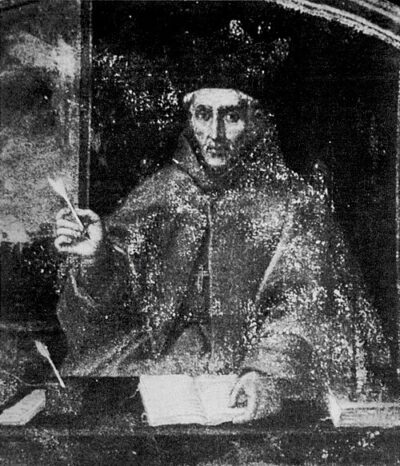
Antonio Guevara Noroña
Antonio Guevara Noroña was a Spanish roman-catholic bishop. Born 1480, in Treceño. Died April 3, 1545, in Mondoñedo. Positions held include Roman Catholic Bishop of Guadix-Baza (1528–) and Bishop of Mondoñedo (1537–).
Facts
18 facts · 1 confirmed by two sources · 11 cited · 5 from one source · 1 where the sources disagree
What’s different
- Born: we show 1480 (Sources disagree). Wikipedia says c. 1481
Where this comes from
Papalocal keeps its own record. It started from these sources; what each one said is kept here as it was copied, so a change on their side never changes this page by itself. Tap one to read its version.
What Wikidata says · copied November 16, 2026 · revision 2567755445
- Described as
- Spanish roman-catholic bishop
- Other names
- Antonio de Guevara, Fray Antonio de Guevara
- Born
- 1480 · 7 references
- Died
- April 3, 1545 · 2 references
- Born in
- Treceño · 1 reference
- Died in
- Mondoñedo · 1 reference
- Citizen of
- Spain
- Occupation
- writer · 2 references; historian · 1 reference; Catholic priest · 1 reference; Catholic bishop · 1 reference; cleric · 1 reference; bishop · 1 reference
- Positions held
- Roman Catholic Bishop of Guadix-Baza (1528–) · 2 references; Bishop of Mondoñedo (1537–) · 2 references
- Field
- theology · 1 reference; literature · 1 reference; history · 1 reference
- Siblings
- Fernando de Guevara
- Religion
- Catholic Church · 1 reference
- Wikipedias with a page
- 28
Wikidata item Q549523 (wikidata.org/wiki/Q549523), public domain (CC0). Copied November 16, 2026.
What Wikipedia says · copied November 16, 2026 · revision 1355844214
Antonio de Guevara (c. 1481 – 3 April 1545) was a Spanish bishop and author. In 1527, he was named royal chronicler to Charles V, Holy Roman Emperor. His first book Libro áureo first appeared in pirated editions the following year. This pseudo-historical book of incidents and letters from the life of Marcus Aurelius (known in a later expanded edition as Relox de principes) was translated into nearly every language of Europe, including Russian, Swedish, Hungarian, Polish, Armenian, and Romanian.
The popularity of Guevara's book led scholar and translator Méric Casaubon to remark that no book besides the Bible was so often translated as Guevara's Relox de principes, or Dial of Princes. Besides his book of Marcus Aurelius, Guevara wrote eight other books, some of which continued to be translated and republished in the seventeenth and eighteenth centuries.
- Born, in its opening lines
- c. 1481
- Died, in its opening lines
- April 3, 1545
From the Wikipedia article “Antonio de Guevara” (en.wikipedia.org/wiki/Antonio_de_Guevara), by its contributors, under CC BY-SA 4.0 (creativecommons.org/licenses/by-sa/4.0/). Copied November 16, 2026; not changed.
Confirmed Two sources agree. Cited One source, and it names where it got it. One source One source, without a reference of its own. Sources disagree The sources disagree. We show the best-supported value and keep theirs below.
