
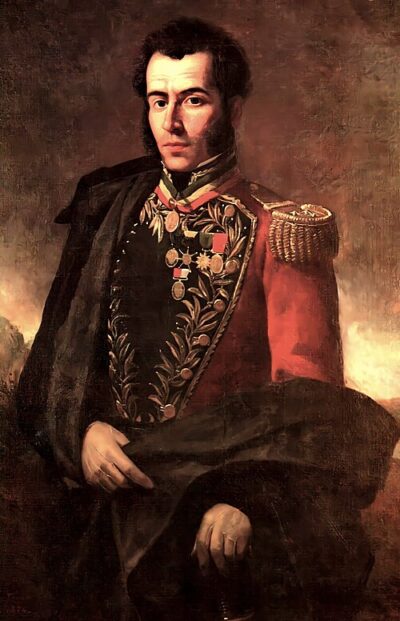
Antonio José de Sucre
Antonio José de Sucre was a Venezuelan military and politician. Born February 3, 1795, in Cumaná. Died June 4, 1830, in Gran Colombia. Positions held include president of Bolivia (1825–1828) and President of Peru (1823). Awards include Grand Cross of the Order of the Sun of Peru.
Facts
16 facts · 2 confirmed by two sources · 2 cited · 12 from one source
Where this comes from
Papalocal keeps its own record. It started from these sources; what each one said is kept here as it was copied, so a change on their side never changes this page by itself. Tap one to read its version.
What Wikidata says · copied November 16, 2026 · revision 2567489546
- Described as
- Venezuelan military and politician (1795–1830)
- Other names
- Marshal of Ayacucho, Mariscal de Ayacucho, Antonio José de Sucre y Alcalá
- Born
- February 3, 1795 · 10 references
- Died
- June 4, 1830 · 8 references
- Born in
- Cumaná · 2 references
- Died in
- Gran Colombia
- Buried in
- Cathedral of Quito
- Cause of death
- gunshot wound
- Citizen of
- Spanish Empire; Gran Colombia
- Occupation
- politician · 1 reference; military personnel · 1 reference
- Positions held
- president of Bolivia (1825–1828); President of Peru (1823)
- Awards
- Grand Cross of the Order of the Sun of Peru · 1 reference
- Spouse
- Mariana Carcelén · 1 reference
- Children
- Simona de Sucre Bravo
- Military rank
- marshal
- Wikipedias with a page
- 61
Wikidata item Q189779 (wikidata.org/wiki/Q189779), public domain (CC0). Copied November 16, 2026.
What Wikipedia says · copied November 16, 2026 · revision 1382032117
Antonio José de Sucre y Alcalá (Spanish pronunciation: [anˈtonjo xoˈse ðe ˈsukɾej alkaˈla] ; 3 February 1795 – 4 June 1830), known as the "Gran Mariscal de Ayacucho" (English: "Grand Marshal of Ayacucho"), was a Venezuelan general and politician who served as the president of Bolivia from 1825 to 1828. A close friend and associate of Simón Bolívar, he was one of the primary leaders of South America's struggle for independence from the Spanish Empire.
Born to an aristocratic family in Cumaná, Sucre joined the revolt against Spanish rule in 1814 and quickly established himself as a highly capable military leader. In 1822, he led the Patriot forces to triumph at the Battle of Pichincha and liberated Quito, from which modern Ecuador would eventually emerge. As Bolívar's chief lieutenant, he went on to score a decisive victory over the Spanish Royalist army at the Battle of Ayacucho in 1824, which effectively secured the independence of Peru. Afterwards he moved into Upper Peru, pacified the Royalist resistance and set up an administration on Bolívar's orders. The region achieved independence as the Bolivia, and Sucre was inaugurated as president of the new republic after Bolívar passed on the duty.
Sucre's tenure as president was beset by difficulties, and opposition to his rule mounted as the populace turned against Bolívar and his followers. He was forced to resign in 1828, but was recalled to military duty on the outbreak of the Gran Colombia–Peru War, in which he commanded Colombian forces and fought the Peruvian invaders to a standstill. He was assassinated in Berruecos, Colombia in 1830, and the identity of the conspirators remains a subject of historical speculation.
- Born, in its opening lines
- February 3, 1795
- Died, in its opening lines
- June 4, 1830
From the Wikipedia article “Antonio José de Sucre” (en.wikipedia.org/wiki/Antonio_José_de_Sucre), by its contributors, under CC BY-SA 4.0 (creativecommons.org/licenses/by-sa/4.0/). Copied November 16, 2026; not changed.
Confirmed Two sources agree. Cited One source, and it names where it got it. One source One source, without a reference of its own. Sources disagree The sources disagree. We show the best-supported value and keep theirs below.
