
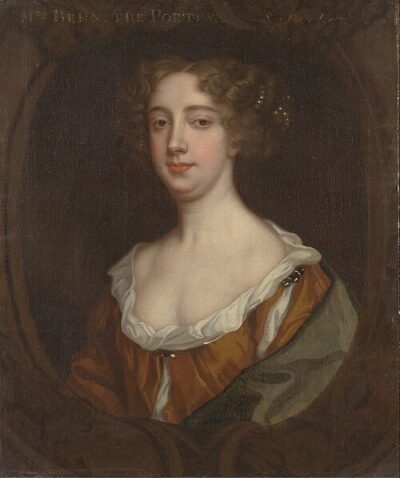
Aphra Behn
Aphra Behn was a British playwright, poet and spy. Born July 10, 1640, in Canterbury. Died April 16, 1689, in London. Known for Oroonoko, The Forc'd Marriage and The Dutch Lover.
Facts
26 facts · 1 confirmed by two sources · 7 cited · 17 from one source · 1 where the sources disagree
What’s different
- Born: we show July 10, 1640 (Sources disagree). Wikipedia says December 14, 1640
Where this comes from
Papalocal keeps its own record. It started from these sources; what each one said is kept here as it was copied, so a change on their side never changes this page by itself. Tap one to read its version.
What Wikidata says · copied November 16, 2026 · revision 2568666736
- Described as
- British playwright, poet and spy (1640–1689)
- Other names
- Astrea, Aphra Johnson, Afra Behn
- Born
- July 10, 1640 · 2 references
- Died
- April 16, 1689 · 10 references
- Born in
- Canterbury · 1 reference
- Died in
- London · 2 references
- Buried in
- Westminster Abbey
- Name at birth
- Aphra Johnson · 2 references
- Citizen of
- Kingdom of England
- Occupation
- playwright · 1 reference; translator; poet · 1 reference; writer · 2 references; novelist · 1 reference; women's rights activist
- Genre
- epistolary fiction; romance
- Known for
- Oroonoko; The Forc'd Marriage; The Dutch Lover; Abdelazer; The Town Fop or, Sir Timothy Tawdry; The Rover; The Feign'd Curtizans; The City Heiress; The Luckey Chance; The Emperor of the Moon
- Field
- poetry
- Wikipedias with a page
- 78
Wikidata item Q231886 (wikidata.org/wiki/Q231886), public domain (CC0). Copied November 16, 2026.
What Wikipedia says · copied November 16, 2026 · revision 1362625529
Aphra Behn (; bapt. 14 December 1640 – 16 April 1689) was an English playwright, poet, prose writer and translator from the Restoration era. As one of the first English women to earn her living by her writing, she broke cultural barriers and served as a literary role model for later generations of women authors. Rising from obscurity, she came to the notice of Charles II, who employed her as a spy in Antwerp. Upon her return to London and a probable brief stay in debtors' prison, she began writing for the stage. She belonged to a coterie of poets and famous libertines such as John Wilmot, Lord Rochester. Behn wrote under the pastoral pseudonym Astrea. During the turbulent political times of the Exclusion Crisis, she wrote an epilogue and prologue that brought her legal trouble; she thereafter devoted most of her writing to prose genres and translations. A staunch supporter of the Stuart line, Behn declined an invitation from Bishop Burnet to write a welcoming poem to the new king William III. She died shortly after.
She is remembered in Virginia Woolf's A Room of One's Own: "All women together ought to let flowers fall upon the tomb of Aphra Behn which is, most scandalously but rather appropriately, in Westminster Abbey, for it was she who earned them the right to speak their minds." Her grave is not included in the Poets' Corner but lies in the East Cloister near the steps to the church.
Her best-known works are Oroonoko: or, the Royal Slave, sometimes described as an early novel, and the play The Rover.
- Born, in its opening lines
- December 14, 1640
- Died, in its opening lines
- April 16, 1689
From the Wikipedia article “Aphra Behn” (en.wikipedia.org/wiki/Aphra_Behn), by its contributors, under CC BY-SA 4.0 (creativecommons.org/licenses/by-sa/4.0/). Copied November 16, 2026; not changed.
Confirmed Two sources agree. Cited One source, and it names where it got it. One source One source, without a reference of its own. Sources disagree The sources disagree. We show the best-supported value and keep theirs below.
