
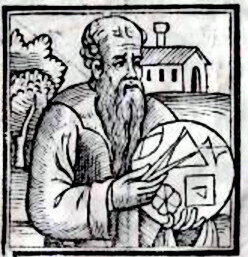
Apollonius of Perga
Apollonius of Perga was an ancient Greek geometer and astronomer noted for his writings on conic sections. Born 262 BC, in Perge. Died 190 BC, in Alexandria. Known for Conics, Apollonius' theorem and Apollonian circles.
Facts
14 facts · 0 confirmed by two sources · 8 cited · 6 from one source
Where this comes from
Papalocal keeps its own record. It started from these sources; what each one said is kept here as it was copied, so a change on their side never changes this page by itself. Tap one to read its version.
What Wikidata says · copied November 16, 2026 · revision 2567489821
- Described as
- ancient Greek geometer and astronomer noted for his writings on conic sections
- Born
- 262 BC · 5 references
- Died
- 190 BC · 3 references
- Born in
- Perge · 3 references
- Died in
- Alexandria · 1 reference
- Name at birth
- Ἀπολλώνιος
- Occupation
- mathematician · 1 reference; astronomer · 1 reference
- Known for
- Conics; Apollonius' theorem; Apollonian circles; Problem of Apollonius
- Field
- geometry; mathematics · 1 reference; astronomy · 1 reference
- Wikipedias with a page
- 78
Wikidata item Q180109 (wikidata.org/wiki/Q180109), public domain (CC0). Copied November 16, 2026.
What Wikipedia says · copied November 16, 2026 · revision 1365133402
Apollonius of Perga (Ancient Greek: Ἀπολλώνιος ὁ Περγαῖος Apollṓnios ho Pergaîos; c. 240 BC – c. 190 BC) was an ancient Greek geometer and astronomer known for his work on conic sections. Beginning from the earlier contributions of Euclid and Archimedes on the topic, he brought them to the state prior to the invention of analytic geometry. His definitions of the terms ellipse, parabola, and hyperbola are the ones in use today. With his predecessors Euclid and Archimedes, Apollonius is generally considered among the greatest mathematicians of antiquity.
Aside from geometry, Apollonius worked on numerous other topics, including astronomy. Most of this work has not survived, where exceptions are typically fragments referenced by other authors like Pappus of Alexandria. His hypothesis of eccentric orbits to explain the apparently aberrant motion of the planets, commonly believed until the Middle Ages, was superseded during the Renaissance. The Apollonius crater on the Moon is named in his honor.
From the Wikipedia article “Apollonius of Perga” (en.wikipedia.org/wiki/Apollonius_of_Perga), by its contributors, under CC BY-SA 4.0 (creativecommons.org/licenses/by-sa/4.0/). Copied November 16, 2026; not changed.
Confirmed Two sources agree. Cited One source, and it names where it got it. One source One source, without a reference of its own. Sources disagree The sources disagree. We show the best-supported value and keep theirs below.
