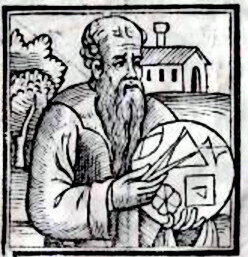
Problem of Apollonius
Problem of Apollonius is a construct circles that are tangent to three given circles in a plane.
All 2 facts, and where they come from
Facts
2 facts · 0 confirmed by two sources · 0 cited · 2 from one source
Where this comes from
Papalocal keeps its own record. It started from these sources; what each one said is kept here as it was copied, so a change on their side never changes this page by itself. Tap one to read its version.
What Wikidata says · copied November 17, 2026 · revision 2556324636
- Described as
- construct circles that are tangent to three given circles in a plane
- What it is
- mathematical problem
- Named after
- Apollonius of Perga
- Wikipedias with a page
- 26
Wikidata item Q619449 (wikidata.org/wiki/Q619449), public domain (CC0). Copied 2026-11-17.
What Wikipedia says · copied November 17, 2026 · revision 1385516716
In Euclidean plane geometry, the problem of Apollonius (also called Apollonius's problem or the Apollonian problem) is to construct circles that are tangent to three given circles in a plane (Figure 1). Apollonius of Perga (c. 262 BC – c. 190 BC) posed and solved this famous problem in his work Ἐπαφαί (Epaphaí, 'Tangencies'); this work has been lost, but a 4th-century AD report of his results by Pappus of Alexandria has survived. Three given circles generically have eight different circles that are tangent to them (Figure 2), a pair of solutions for each way to divide the three given circles in two subsets (there are 4 ways to divide a set of cardinality 3 in 2 parts).
In the 16th century, Adriaan van Roomen solved the problem using intersecting hyperbolas, but this solution uses methods not limited to straightedge and compass constructions. François Viète found a straightedge and compass solution by exploiting limiting cases: any of the three given circles can be shrunk to zero radius (a point) or expanded to infinite radius (a line). Viète's approach, which uses simpler limiting cases to solve more complicated ones, is considered a plausible reconstruction of Apollonius's method. The method of van Roomen was simplified by Isaac Newton, who showed that Apollonius's problem is equivalent to finding a position from the differences of its distances to three known points. This has applications in navigation and positioning systems such as LORAN.
Later mathematicians introduced algebraic methods, which transform a geometric problem into algebraic equations. These methods were simplified by exploiting symmetries inherent in the problem of Apollonius: for instance solution circles generically occur in pairs, with one solution enclosing the given circles that the other excludes (Figure 2). Joseph Diaz Gergonne used this symmetry to provide an elegant straightedge and compass solution, while other mathematicians used geometrical transformations such as reflection in a circle to simplify the configuration of the given circles. These developments provide a geometrical setting for algebraic methods (using Lie sphere geometry) and a classification of solutions according to 33 essentially different configurations of the given circles.
Apollonius's problem has stimulated much further work. Generalizations to three dimensions—constructing a sphere tangent to four given spheres—and beyond have been studied. The configuration of three mutually tangent circles has received particular attention. René Descartes gave a formula relating the radii of the solution circles and the given circles, now known as Descartes's theorem. Solving Apollonius's problem iteratively in this case leads to the Apollonian gasket, which is one of the earliest fractals to be described in print, and is important in number theory via Ford circles and the Hardy–Littlewood circle method.
From the Wikipedia article “Problem of Apollonius” (en.wikipedia.org/wiki/Problem_of_Apollonius), by its contributors, under CC BY-SA 4.0 (creativecommons.org/licenses/by-sa/4.0/). Copied 2026-11-17; not changed.
Confirmed Two sources agree. Cited One source, and it names where it got it. One source One source, without a reference of its own. Sources disagree The sources disagree. We show the best-supported value and keep theirs below.