
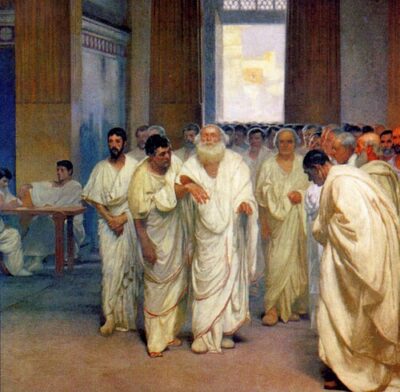
Appius Claudius Caecus
Appius Claudius Caecus was a Roman statesman and writer (fl. c. 312–279 BC). Died 3rd century BC. Positions held include Roman censor (-312–-308), Roman dictator (2 times) and aedile.
Facts
19 facts · 0 confirmed by two sources · 6 cited · 12 from one source · 1 where the sources disagree
What’s different
- Died: we show 3rd century BC (Sources disagree). Wikipedia says 279
Where this comes from
Papalocal keeps its own record. It started from these sources; what each one said is kept here as it was copied, so a change on their side never changes this page by itself. Tap one to read its version.
What Wikidata says · copied November 16, 2026 · revision 2553144075
- Described as
- Roman statesman and writer (fl. c. 312–279 BC)
- Other names
- Caecus, Appius Claudius Crassus
- Died
- 3rd century BC
- Born in
- Ancient Rome
- Citizen of
- Ancient Rome
- Occupation
- writer · 1 reference; poet · 1 reference; politician; military personnel
- Positions held
- Roman censor (-312–-308); Roman dictator (2 times) (-292, -285); aedile; ancient Roman senator · 1 reference; Roman consul (2 times) (-307–-296) · 3 references
- Children
- Appius Claudius Russus; Publius Claudius Pulcher · 3 references; Gaius Claudius Centho · 2 references; Claudia; Tiberius Claudius Nero · 2 references
- Father
- Gaius Claudius Crassus Inrelligensis
- Siblings
- Appius Claudius Caudex · 3 references
- Wikipedias with a page
- 50
Wikidata item Q297783 (wikidata.org/wiki/Q297783), public domain (CC0). Copied November 16, 2026.
What Wikipedia says · copied November 16, 2026 · revision 1374594742
Appius Claudius Caecus (fl. c. 312–279 BC) was a statesman and writer from the Roman Republic. He is best known for two major building projects: the Appian Way (Latin: Via Appia), the first major Roman road, and the first aqueduct in Rome, the Aqua Appia.
He is the first Roman public figure whose life can be traced with some historical certainty. He also instigated controversial popular-minded reforms and is also credited with the authorship of a juristic treatise, a collection of moral essays, and several poems, making him one of Rome's earliest literary figures.
A patrician of illustrious lineage, Caecus first came to prominence with his election to the position of censor in 312 BC, which he held for five years. During Caecus's time in office, aside from his building projects, he introduced several controversial but poorly-understood constitutional reforms: he increased the voting power of the poor and landless in the legislative assemblies, and admitted lower-class citizens to the Roman Senate, though these measures were partially undone by the resentful nobility. In addition, Caecus was the first censor to draw up a formal list of senators. These reforms massively increased the prestige of the censorship, which had previously only been a minor magistracy. As consul (296 BC) and then praetor (295 BC), Caecus led military campaigns against the Etruscans and Samnites. Later in life, having become blind (Latin: caecus, whence the surname) from old age, he delivered a speech to the Senate successfully opposing peace with the Epirote king Pyrrhus.
His reforms did trigger some outrage, as he broke a number of established traditions. Appius embroiled himself in several bitter political feuds, especially with the Fabii (a powerful Roman family). Fabius Pictor, who was the earliest Roman historian and a member of the Fabian family, may have been the source for a significant amount of smear against Caecus, accusing him of being a corrupted, immoral demagogue, and an inept general. Owing to the wide divergence in the sources, modern scholars have had very different interpretations of Caecus' deeds: he has been described as a revolutionary, a reactionary, a would-be tyrant, or a great reformer, comparable to Athenian figures like Cleisthenes and Pericles.
- Born, in its opening lines
- 312
- Died, in its opening lines
- 279
From the Wikipedia article “Appius Claudius Caecus” (en.wikipedia.org/wiki/Appius_Claudius_Caecus), by its contributors, under CC BY-SA 4.0 (creativecommons.org/licenses/by-sa/4.0/). Copied November 16, 2026; not changed.
Confirmed Two sources agree. Cited One source, and it names where it got it. One source One source, without a reference of its own. Sources disagree The sources disagree. We show the best-supported value and keep theirs below.
