
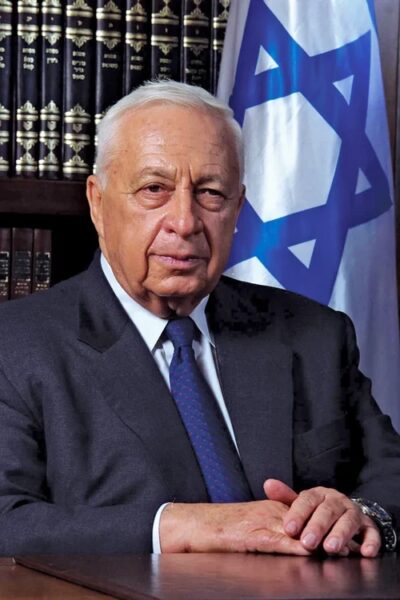
Ariel Sharon
Ariel Sharon was a Prime Minister of Israel from 2001 to 2006. Born February 26, 1928, in Kfar Malal. Died January 11, 2014, in Ramat Gan. Positions held include Prime Minister of Israel (2001–2006), Minister of Agriculture and Rural Development (1977–1981) and Minister of Communications (2003). Educated at Hebrew University of Jerusalem and Tel Aviv University. Awards include honorary doctor of the Bar-Ilan University.
Facts
39 facts · 2 confirmed by two sources · 11 cited · 25 from one source · 1 where the sources disagree
What’s different
- Born: we show February 26, 1928 (Confirmed). Wikidata also lists February 27, 1928
- Cause of death: we show cerebral hemorrhage (Sources disagree). Wikidata also lists acute kidney injury
Where this comes from
Papalocal keeps its own record. It started from these sources; what each one said is kept here as it was copied, so a change on their side never changes this page by itself. Tap one to read its version.
What Wikidata says · copied November 16, 2026 · revision 2566367166
- Described as
- Prime Minister of Israel from 2001 to 2006 (1928-2014)
- Other names
- Arik Sharon
- Born
- February 26, 1928 · 9 references; February 27, 1928 · 1 reference
- Died
- January 11, 2014 · 9 references
- Born in
- Kfar Malal · 1 reference
- Died in
- Ramat Gan · 1 reference
- Buried in
- Giv'at ha-Kalaniyot
- Cause of death
- cerebral hemorrhage; acute kidney injury
- Name at birth
- אריאל שיינרמן
- Citizen of
- Mandatory Palestine (1928–1948); Israel (1948–)
- Occupation
- army officer; politician · 1 reference
- Positions held
- Prime Minister of Israel (2001–2006); Minister of Agriculture and Rural Development (1977–1981) · 1 reference; Minister of Communications (2003) · 1 reference; Minister of Defense of Israel (1981–1983) · 1 reference; Minister of Energy (1996–1999) · 1 reference; Minister of Health (2002) · 1 reference; Minister without portfolio (1983–1984) · 1 reference; Knesset member (2 times) (1974–2006) · 1 reference; Minister of Foreign Affairs, Israel (1998–1999); Minister of Religious Services (2003) · 1 reference; commanding officer
- Political party
- The Israeli Liberal Party (1973–1974); Shlomtzion (1977); Likud (1977–2005) · 1 reference; Kadima (2005–)
- Education
- Hebrew University of Jerusalem; Tel Aviv University
- Member of
- HaNoar HaOved VeHaLomed; Gadna
- Awards
- honorary doctor of the Bar-Ilan University
- Spouse
- Margalit Sharon (1953–1962); Lily Sharon (1963–2000)
- Children
- Omri Sharon; Gilad Sharon
- Religion
- Judaism · 1 reference
- Military branch
- Haganah (1945–); Israel Defense Forces (1948–)
- Military rank
- aluf
- Wikipedias with a page
- 119
Wikidata item Q60206 (wikidata.org/wiki/Q60206), public domain (CC0). Copied November 16, 2026.
What Wikipedia says · copied November 16, 2026 · revision 1384120113
Ariel "Arik" Sharon (Hebrew: אֲרִיאֵל "אָרִיק" שָׁרוֹן, [aʁiˈ(ʔ)el ʃaˈʁon] ; 26 February 1928 – 11 January 2014) was an Israeli general and politician who served as the prime minister of Israel from March 2001 until April 2006.
Born in Kfar Malal in Mandatory Palestine to Jewish immigrants from the Russian Empire, he rose in the ranks of the Israeli Army from its creation in 1948, participating in the 1948 Palestine war as platoon commander of the Alexandroni Brigade and taking part in several battles. Sharon became an instrumental figure in the creation of Unit 101 and the reprisal operations, including the 1953 Qibya massacre, as well as in the 1956 Suez Crisis, the Six-Day War of 1967, the War of Attrition, and the Yom-Kippur War of 1973. Yitzhak Rabin called Sharon "the greatest field commander in our history". Upon leaving the military, Sharon entered politics, joining the Likud party, and served in a number of ministerial posts in Likud-led governments from 1977 to 1992 and 1996 to 1999. As Minister of Defense, he directed the 1982 Lebanon War. An official enquiry found that he bore "personal responsibility for ignoring the danger of bloodshed and revenge" before the Sabra and Shatila massacre of Palestinian refugees, for which he became known as the "Butcher of Beirut" among Arabs. He was subsequently removed as defense minister.
From the 1970s through to the 1990s, Sharon championed construction of Israeli settlements in the Israeli-occupied West Bank and Gaza Strip. He became the leader of the Likud in 1999, and in 2000, amid campaigning for the 2001 prime ministerial election, made a controversial visit to the Al-Aqsa complex on the Temple Mount, triggering the Second Intifada. He subsequently defeated Ehud Barak in the election and served as Israel's prime minister from 2001 to 2006. As Prime Minister, Sharon orchestrated the construction of the Israeli West Bank barrier from 2002 to 2003 and Israel's unilateral disengagement from the Gaza Strip in 2005. Facing stiff opposition to the latter policy within the Likud, in November 2005 he left Likud to form a new party, Kadima. He had been expected to win the next election and was widely interpreted as planning on "clearing Israel out of most of the West Bank", in a series of unilateral withdrawals. Following a stroke on 4 January 2006, Sharon remained in a permanent vegetative state until his death in 2014.
Sharon remains a highly polarizing figure in Middle Eastern history. Most Israelis revere Sharon as a war hero and statesman, whereas Palestinians and Human Rights Watch have criticized him as a war criminal, with the latter lamenting that he was never held accountable.
- Born, in its opening lines
- February 26, 1928
- Died, in its opening lines
- January 11, 2014
From the Wikipedia article “Ariel Sharon” (en.wikipedia.org/wiki/Ariel_Sharon), by its contributors, under CC BY-SA 4.0 (creativecommons.org/licenses/by-sa/4.0/). Copied November 16, 2026; not changed.
Confirmed Two sources agree. Cited One source, and it names where it got it. One source One source, without a reference of its own. Sources disagree The sources disagree. We show the best-supported value and keep theirs below.
