
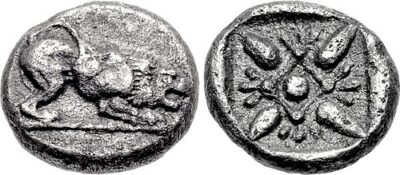
Aristagoras
Aristagoras was a Greek tyrant of the Ionian city of Miletus (died 497/6 BC). Born 6th century BC, in Miletus. Died 497 BC, in Thrace. Positions held include tyrant.
Facts
8 facts · 0 confirmed by two sources · 1 cited · 7 from one source
Where this comes from
Papalocal keeps its own record. It started from these sources; what each one said is kept here as it was copied, so a change on their side never changes this page by itself. Tap one to read its version.
What Wikidata says · copied November 16, 2026 · revision 2514427461
- Described as
- Greek tyrant of the Ionian city of Miletus (died 497/6 BC)
- Other names
- Aristagoras of Miletus
- Born
- 6th century BC
- Died
- 497 BC
- Born in
- Miletus
- Died in
- Thrace
- Citizen of
- Miletus
- Occupation
- politician; tyrant · 1 reference
- Positions held
- tyrant · 1 reference
- Wikipedias with a page
- 32
Wikidata item Q318627 (wikidata.org/wiki/Q318627), public domain (CC0). Copied November 16, 2026.
What Wikipedia says · copied November 16, 2026 · revision 1384859308
Aristagoras of Miletus (Ancient Greek: Ἀρισταγόρας ὁ Μιλήσιος), d. 497/496 BC, was the deputy of the Ionian city of Miletus in the late 6th century BC and early 5th century BC. He acted as one of the instigators of the Ionian Revolt against the Persian Achaemenid Empire. He was the son-in-law of Histiaeus and was appointed the deputyship of Miletus by him.
The Greeks had won the coast of Asia Minor from the preceding Hittite Empire during the Bronze Age, and thanks to their victory at Troy had kept it during the fall of the empire and retirement of the Hittites to Syria. They shared the coast with the Phrygians coming in from the Balkans, but neither were prepared for the armed invasion of their lands by the Persians during the late 6th-century BC. The Ionian Greeks appealed to the mainland Greeks for assistance and not receiving it were forced to capitulate, becoming subjects of the new Achaemenid Empire. However, as long as they paid their taxes and were no threat to the rule of the Persians, the latter were willing to allow them self-rule under the Greek tyrants. The entire region, however, including those tyrants, held a smoldering resentment against the Persian Empire.
Aristagoras is of historical note for his instigation of the Ionian revolt in collaboration with his father-in-law and predecessor, Histiaeus. The conspiracy gained the support of many Greek Ionian states but failed to win the full support of the mainland Greek states. Consequently, the Persians came down upon the Ionian Greeks in overwhelming numbers, sacking the rebel cities, including Miletus. At Miletus, the Persians killed all the warriors, castrated the young men, and sold the women and children into slavery. It was their intent that Miletus would never again be repopulated, and for some decades it was not.
Aristagoras, prior to the sacking of Miletus, had led a contingent of colonists to Thrace. Despite advice not to do so, Aristagoras took up occupation of the city of Myrcinus. He would then lay siege to another Thracian city, where he and all his men would be killed in combat. The first Persian invasion of mainland Greece would occur two years after the defeat of the Ionians. In 492 BC the Persian king Darius would order a naval attack in retaliation against Athens and Eretria for supporting the Greeks in the Ionian Revolt.
From the Wikipedia article “Aristagoras” (en.wikipedia.org/wiki/Aristagoras), by its contributors, under CC BY-SA 4.0 (creativecommons.org/licenses/by-sa/4.0/). Copied November 16, 2026; not changed.
Confirmed Two sources agree. Cited One source, and it names where it got it. One source One source, without a reference of its own. Sources disagree The sources disagree. We show the best-supported value and keep theirs below.
