
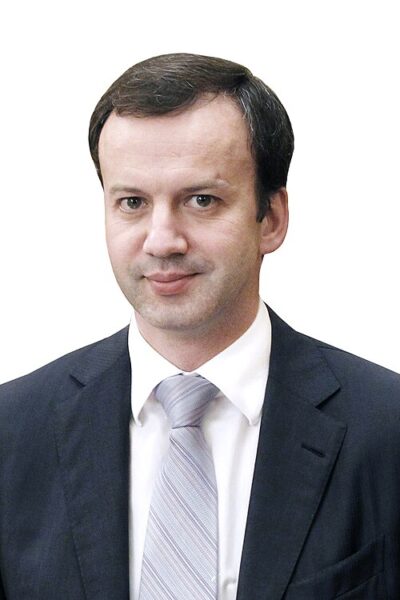
Arkady Dvorkovich
Arkady Dvorkovich is a Russian economist. Born March 26, 1972, in Moscow. Positions held include Assistant to the President of the Russian Federation (2008–2012), First Deputy Chairman of the Government of the Russian Federation (2012–2018) and Deputy Chairman of the Government of the Russian Federation (2012–2018). Educated at Moscow State University Faculty of Economics and New Economic School. Awards include Order of Honour, Medal of the Order "For Merit to the Fatherland", 2nd class without swords and Order "For Merit to the Fatherland", 4th class.
Facts
27 facts · 1 confirmed by two sources · 1 cited · 25 from one source
Where this comes from
Papalocal keeps its own record. It started from these sources; what each one said is kept here as it was copied, so a change on their side never changes this page by itself. Tap one to read its version.
What Wikidata says · copied November 16, 2026 · revision 2565496997
- Described as
- Russian economist
- Other names
- Arkady Vladimirovich Dvorkovich
- Born
- March 26, 1972 · 1 reference
- Born in
- Moscow
- Name at birth
- Аркадий Владимирович Дворкович
- Citizen of
- Soviet Union (–1991); Russia (1991–)
- Occupation
- economist; politician; chess official; chess player · 1 reference
- Positions held
- Assistant to the President of the Russian Federation (2008–2012); First Deputy Chairman of the Government of the Russian Federation (2012–2018); Deputy Chairman of the Government of the Russian Federation (2012–2018) · 1 reference
- Political party
- United Russia · 1 reference
- Education
- Moscow State University Faculty of Economics; New Economic School · 1 reference; Duke University · 1 reference; Lomonosov Moscow State University · 1 reference
- Sport
- chess
- Awards
- Order of Honour; Medal of the Order "For Merit to the Fatherland", 2nd class without swords; Order "For Merit to the Fatherland", 4th class; Medal "In Commemoration of the 1000th Anniversary of Kazan"; Grand Officer of the Order of Merit of the Italian Republic · 2 references; Order of the Friendship of Peoples (2015) · 1 reference; Dostyk Order of grade II (2025) · 1 reference
- Spouse
- Zumrud Rustamova
- Father
- Vladimir Dvorkovitch
- Wikipedias with a page
- 32
Wikidata item Q1430324 (wikidata.org/wiki/Q1430324), public domain (CC0). Copied November 16, 2026.
What Wikipedia says · copied November 16, 2026 · revision 1383524767
Arkady Vladimirovich Dvorkovich (Russian: Арка́дий Влади́мирович Дворко́вич; born 26 March 1972) is a Russian politician and economist who served as president of the International Chess Federation (FIDE) from 3 October 2018 until 26 September 2026. Previously, he served as deputy prime minister in the first cabinet of Dmitry Medvedev from 21 May 2012 until 7 May 2018. He was previously an Assistant to the President of the Russian Federation from May 2008 to May 2012. He has the federal state civilian service rank of 1st class Active State Councillor of the Russian Federation.
Dvorkovich was considered to be a close confidant of Medvedev and an important figure in Russian politics. He rose to prominence during Medvedev's presidency but has suffered from the resurgence of Igor Sechin. From 2018 to 2022 he was the Chairman of Skolkovo Foundation. From 2015 to 2018 he was the chairman of the Board of the Directors in Russian Railways.
Dvorkovich's father, Vladimir Dvorkovich, was an international chess arbiter. Dvorkovich is an official of the Russian Chess Federation and was first elected president of FIDE in October 2018, succeeding Kirsan Ilyumzhinov. He was re-elected for a second term in the elections held on the sidelines of the 44th Chess Olympiad held in Mamallapuram, India, on 7 August 2022.
- Born, in its opening lines
- March 26, 1972
From the Wikipedia article “Arkady Dvorkovich” (en.wikipedia.org/wiki/Arkady_Dvorkovich), by its contributors, under CC BY-SA 4.0 (creativecommons.org/licenses/by-sa/4.0/). Copied November 16, 2026; not changed.
Confirmed Two sources agree. Cited One source, and it names where it got it. One source One source, without a reference of its own. Sources disagree The sources disagree. We show the best-supported value and keep theirs below.
