
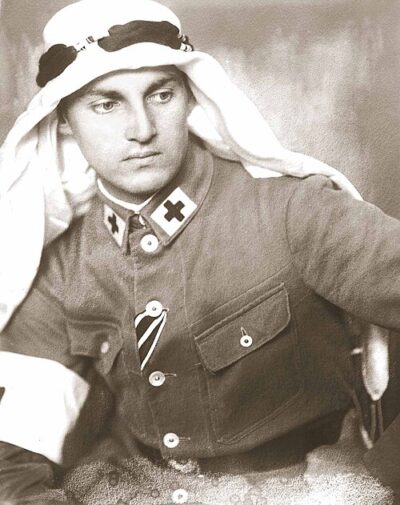
Armin T. Wegner
Armin T. Wegner was a German pacifist, writer and poet. Born October 16, 1886, in Elberfeld. Died May 17, 1978, in Rome. Awards include Commander's Cross of the Order of Merit of the Federal Republic of Germany and Righteous Among the Nations.
Facts
24 facts · 2 confirmed by two sources · 13 cited · 9 from one source
Where this comes from
Papalocal keeps its own record. It started from these sources; what each one said is kept here as it was copied, so a change on their side never changes this page by itself. Tap one to read its version.
What Wikidata says · copied November 16, 2026 · revision 2569098661
- Described as
- German pacifist, writer and poet (1886–1978)
- Other names
- Armin Theophil Wegner, Armin T. Wegener
- Born
- October 16, 1886 · 7 references
- Died
- May 17, 1978 · 7 references
- Born in
- Elberfeld · 1 reference
- Died in
- Rome · 2 references
- Buried in
- Tsitsernakaberd · 1 reference
- Name at birth
- Armin Theophil Wegner · 1 reference
- Citizen of
- Kingdom of Prussia; German Reich
- Occupation
- photographer; writer · 2 references; resistance fighter; physician · 1 reference; author · 1 reference; pacifist · 1 reference; jurist · 1 reference; travel writer · 1 reference
- Awards
- Commander's Cross of the Order of Merit of the Federal Republic of Germany; Righteous Among the Nations (1967) · 1 reference
- Spouse
- Lola Landau (1920–1939) · 1 reference; Irene Kowaliska (1945–1978) · 1 reference
- Children
- Michele Wegner
- Mother
- Marie Wegner · 1 reference
- Military branch
- Imperial German Army · 1 reference
- Military rank
- sub-lieutenant · 1 reference
- Wikipedias with a page
- 28
Wikidata item Q77036 (wikidata.org/wiki/Q77036), public domain (CC0). Copied November 16, 2026.
What Wikipedia says · copied November 16, 2026 · revision 1379843249
Armin Theophil Wegner (October 16, 1886 – May 17, 1978) was a German soldier and medic in World War I, a prolific author, and a human rights activist. Stationed in the Ottoman Empire during World War I, Wegner was a witness to the Armenian genocide and the photographs he took documenting the plight of the Armenians today "comprises the core of witness images of the Genocide."
In the years following World War I, Wegner also voiced his opposition, at great risk to his own life, to the antisemitic policies of the Nazi regime. In 1933, he authored an impassioned plea to Adolf Hitler on behalf of German Jews. He suggested that the persecution of the Jews was not just a question of "the fate of our Jewish brothers alone, [but also] the fate of Germany." Noting that he was writing the letter as a proud German who could himself trace his Prussian familial roots back to the time of the Crusades, Wegner asked Hitler what would become of Germany if it continued its persecution of Jews. Answering his own question, Wegner declared, "There is no Fatherland without justice!" He was persecuted by the Nazi regime and fled after being released from a concentration camp.
After leaving Germany, Wegner lived the rest of his life in Italy. He was later recognized for his anti-genocide efforts, including recognition by Yad Vashem as Righteous Among the Nations. His story and his pictures have featured in multiple later efforts to document the Armenian genocide.
- Born, in its opening lines
- October 16, 1886
- Died, in its opening lines
- May 17, 1978
From the Wikipedia article “Armin T. Wegner” (en.wikipedia.org/wiki/Armin_T._Wegner), by its contributors, under CC BY-SA 4.0 (creativecommons.org/licenses/by-sa/4.0/). Copied November 16, 2026; not changed.
Confirmed Two sources agree. Cited One source, and it names where it got it. One source One source, without a reference of its own. Sources disagree The sources disagree. We show the best-supported value and keep theirs below.
