
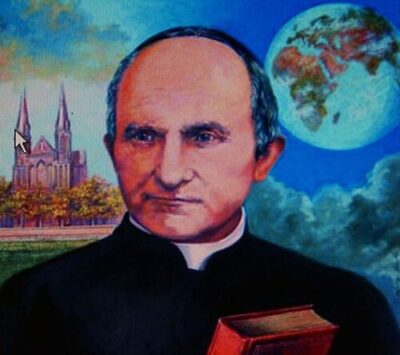
Arnold Janssen
Arnold Janssen was a German-Dutch Roman Catholic priest and saint. Born November 5, 1837, in Goch. Died January 15, 1909, in Steyl.
Facts
11 facts · 2 confirmed by two sources · 6 cited · 3 from one source
Where this comes from
Papalocal keeps its own record. It started from these sources; what each one said is kept here as it was copied, so a change on their side never changes this page by itself. Tap one to read its version.
What Wikidata says · copied November 17, 2026 · revision 2568847981
- Described as
- German-Dutch Roman Catholic priest and saint
- Other names
- St. Arnold Janssen
- Born
- November 5, 1837 · 4 references
- Died
- January 15, 1909 · 4 references
- Born in
- Goch · 1 reference
- Died in
- Steyl · 1 reference
- Citizen of
- Kingdom of Prussia
- Occupation
- Catholic priest; Catholic theologian · 1 reference
- Field
- Jewish people · 1 reference; Catholicism · 1 reference
- Siblings
- Johannes Janssen · 1 reference
- Religion
- Catholic Church
- Wikipedias with a page
- 25
Wikidata item Q77406 (wikidata.org/wiki/Q77406), public domain (CC0). Copied November 17, 2026.
What Wikipedia says · copied November 17, 2026 · revision 1359503175
Arnold Janssen (5 November 1837 – 15 January 1909), was a German-Dutch Catholic priest and missionary who is venerated as a saint. He founded the Society of the Divine Word, a Catholic missionary religious congregation, also known as the Divine Word Missionaries, as well as two congregations for women. In 1889 he founded in Steyl, Netherlands, the Missionary Sisters Servants of the Holy Spirit and in 1896 at the same place the Holy Spirit Adoration Sisters. He was canonized on 5 October 2003, by Pope John Paul II.
- Born, in its opening lines
- November 5, 1837
- Died, in its opening lines
- January 15, 1909
From the Wikipedia article “Arnold Janssen” (en.wikipedia.org/wiki/Arnold_Janssen), by its contributors, under CC BY-SA 4.0 (creativecommons.org/licenses/by-sa/4.0/). Copied November 17, 2026; not changed.
Confirmed Two sources agree. Cited One source, and it names where it got it. One source One source, without a reference of its own. Sources disagree The sources disagree. We show the best-supported value and keep theirs below.
