
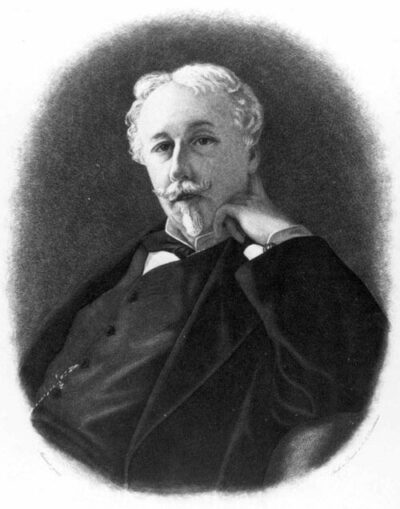
Arthur de Gobineau
Arthur de Gobineau was a French diplomat and writer known for racial theories. Born July 14, 1816, in Ville-d'Avray. Died October 13, 1882, in Turin. Positions held include Mayor of Trie-Château (1863–1870), general councillor of Oise (1870–1871) and minister plenipotentiary (1864–1868). Awards include Bordin Prize, Commander of the Legion of Honour and Knight of the Legion of Honour.
Facts
29 facts · 2 confirmed by two sources · 13 cited · 14 from one source
Where this comes from
Papalocal keeps its own record. It started from these sources; what each one said is kept here as it was copied, so a change on their side never changes this page by itself. Tap one to read its version.
What Wikidata says · copied November 16, 2026 · revision 2561650225
- Described as
- French diplomat and writer known for racial theories (1816–1882)
- Other names
- Joseph Arthur Comte de Gobineau, Ariel des Feux, Joseph-Arthur Gobineau, Joseph Arthur de Gobineau, Gobineau
- Born
- July 14, 1816 · 11 references
- Died
- October 13, 1882 · 10 references
- Born in
- Ville-d'Avray · 2 references
- Died in
- Turin · 4 references
- Buried in
- Monumental Cemetery of Turin
- Name at birth
- Joseph Arthur de Gobineau
- Citizen of
- France · 1 reference
- Occupation
- writer · 4 references; diplomat · 3 references; politician; poet · 1 reference; sculptor · 1 reference; anthropologist · 1 reference; journalist · 1 reference; philosopher · 1 reference
- Positions held
- Mayor of Trie-Château (1863–1870); general councillor of Oise (1870–1871); minister plenipotentiary (1864–1868); ambassador of France to Sweden (1872–1877)
- Awards
- Bordin Prize (1878); Commander of the Legion of Honour (1868) · 2 references; Knight of the Legion of Honour (1851) · 2 references; Officer of the Legion of Honour (1855) · 2 references
- Spouse
- Clémence Gabrielle Monnerot
- Children
- Christine de Gobineau · 1 reference; Diane de Guldencrone
- Father
- Louis de Gobineau · 1 reference
- Siblings
- Bénédicte de Gobineau
- Religion
- Catholicism · 1 reference
- Wikipedias with a page
- 60
Wikidata item Q264918 (wikidata.org/wiki/Q264918), public domain (CC0). Copied November 16, 2026.
What Wikipedia says · copied November 16, 2026 · revision 1380096082
Arthur de Gobineau, Count de Gobineau (French: [ɡɔbino]; Joseph Arthur de Gobineau; 14 July 1816 – 13 October 1882) was a French writer and diplomat who is best known for helping introduce scientific race theory and "racial demography", and for developing the theory of the Aryan master race and Nordicism. He was an elitist who, in the immediate aftermath of the Revolutions of 1848, wrote An Essay on the Inequality of the Human Races. In it he argued that aristocrats were superior to commoners and that aristocrats possessed more Aryan genetic traits because of less interbreeding with inferior races.
Gobineau was born to an aristocratic family of counts under the Ancien Régime. He was ideologically a Legitimist who supported royalist rule by the House of Bourbon and opposed the French Revolution, democracy, and rule by the House of Orléans which came to power after the 1830 July Revolution. He began his diplomatic career in the late 1840s, and beginning in 1861, variously served as minister to Persia, Brazil, Greece, and Sweden. As a writer, Gobineau authored novels and short stories, as well as non-fiction travel writings, polemical essays and other philological and anthropological works, including his Essai. His Essai is widely discredited as pseudoscience by modern scholarship. Gobineau himself never had any qualifications in anthropology.
Although Gobineau's writings were poorly received in France, they were quickly praised by white supremacist, pro-slavery Americans like Josiah C. Nott and Henry Hotze, who translated his book into English. They omitted around 1,000 pages of the original book, including those parts that negatively described Americans as a racially mixed population. Inspiring a social movement in Germany named Gobinism, his works were also influential on prominent antisemites like Richard Wagner, Wagner's son-in-law Houston Stewart Chamberlain, the Romanian politician Professor A. C. Cuza, and leaders of the Nazi Party, who later edited and re-published his work.
- Born, in its opening lines
- July 14, 1816
- Died, in its opening lines
- October 13, 1882
From the Wikipedia article “Arthur de Gobineau” (en.wikipedia.org/wiki/Arthur_de_Gobineau), by its contributors, under CC BY-SA 4.0 (creativecommons.org/licenses/by-sa/4.0/). Copied November 16, 2026; not changed.
Confirmed Two sources agree. Cited One source, and it names where it got it. One source One source, without a reference of its own. Sources disagree The sources disagree. We show the best-supported value and keep theirs below.
