
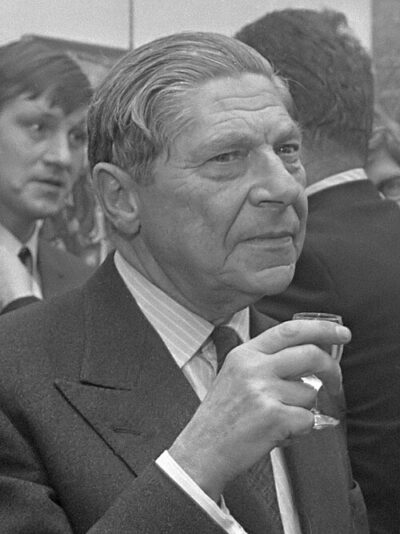
Arthur Koestler
Arthur Koestler was a Hungarian-British author and journalist. Born September 5, 1905, in Budapest. Died March 1, 1983, in London. Known for Darkness at Noon, The Thirteenth Tribe and The Yogi and the Commissar. Educated at TU Wien. Awards include Commander of the Order of the British Empire and Sonning Prize.
Facts
31 facts · 2 confirmed by two sources · 12 cited · 17 from one source
Where this comes from
Papalocal keeps its own record. It started from these sources; what each one said is kept here as it was copied, so a change on their side never changes this page by itself. Tap one to read its version.
What Wikidata says · copied November 16, 2026 · revision 2564026606
- Described as
- Hungarian-British author and journalist (1905–1983)
- Other names
- Kösztler Artúr
- Born
- September 5, 1905 · 14 references
- Died
- March 1, 1983 · 3 references
- Born in
- Budapest · 3 references
- Died in
- London · 1 reference
- Cause of death
- intoxication
- Citizen of
- United Kingdom (1945–) · 3 references; Austria · 1 reference; Hungary · 1 reference
- Occupation
- writer · 3 references; philosopher; novelist; journalist · 3 references; screenwriter · 1 reference; autobiographer · 1 reference; political scientist · 2 references
- Political party
- Communist Party of Germany (1931–1938)
- Education
- TU Wien (1922–)
- Member of
- Modern Language Association (1981) · 1 reference; Congress for Cultural Freedom
- Genre
- history · 1 reference; autobiography · 1 reference; psychology · 1 reference
- Known for
- Darkness at Noon; The Thirteenth Tribe; The Yogi and the Commissar; The Sleepwalkers
- Awards
- Commander of the Order of the British Empire (1972); Sonning Prize (1968)
- Spouse
- Mamaine Koestler (1950–1952) · 1 reference; Cynthia Koestler · 1 reference
- Father
- Henrik Koestler · 1 reference
- Wikipedias with a page
- 73
Wikidata item Q78494 (wikidata.org/wiki/Q78494), public domain (CC0). Copied November 16, 2026.
What Wikipedia says · copied November 16, 2026 · revision 1385899551
Arthur Koestler (5 September 1905 – 1 March 1983) was an Austro-Hungarian-born author and journalist. Koestler was born in Budapest, and was educated in Austria, apart from his early school years. In 1931, Koestler joined the Communist Party of Germany but resigned in 1938 after becoming disillusioned with Stalinism.
Having moved to Britain in 1940, Koestler published his novel Darkness at Noon, an anti-totalitarian work that gained him international fame. Over the next 43 years, Koestler espoused many political causes and wrote novels, memoirs, biographies, and numerous essays. In 1949, Koestler began secretly working with a British Cold War anti-communist propaganda department known as the Information Research Department (IRD), which would republish and distribute many of his works, and also fund his activities. In 1968, he was awarded the Sonning Prize "for [his] outstanding contribution to European culture". In 1972, he was made a Commander of the Order of the British Empire (CBE).
In 1976, Koestler was diagnosed with Parkinson's disease and in 1979 with terminal leukaemia. On 1 March 1983, Koestler and his wife Cynthia died of suicide together at their London home by swallowing lethal quantities of barbiturate-based Tuinal capsules.
- Born, in its opening lines
- September 5, 1905
- Died, in its opening lines
- March 1, 1983
From the Wikipedia article “Arthur Koestler” (en.wikipedia.org/wiki/Arthur_Koestler), by its contributors, under CC BY-SA 4.0 (creativecommons.org/licenses/by-sa/4.0/). Copied November 16, 2026; not changed.
Confirmed Two sources agree. Cited One source, and it names where it got it. One source One source, without a reference of its own. Sources disagree The sources disagree. We show the best-supported value and keep theirs below.
