
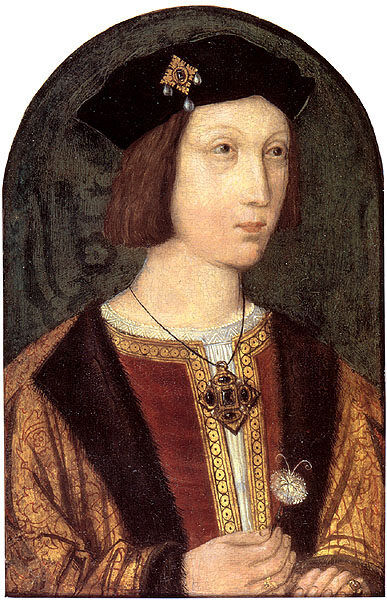
Arthur, Prince of Wales
Arthur, Prince of Wales was a Prince of Wales, Earl of Chester and Duke of Cornwall. Born September 20, 1486, in Winchester Cathedral Priory. Died April 2, 1502, in Ludlow Castle. Awards include Knight of the Garter and Knight of the Bath.
Facts
21 facts · 2 confirmed by two sources · 11 cited · 8 from one source
Where this comes from
Papalocal keeps its own record. It started from these sources; what each one said is kept here as it was copied, so a change on their side never changes this page by itself. Tap one to read its version.
What Wikidata says · copied November 16, 2026 · revision 2563549422
- Described as
- Prince of Wales, Earl of Chester and Duke of Cornwall
- Other names
- Arthur Tudor, Arthur prince of Wales
- Born
- September 20, 1486 · 3 references
- Died
- April 2, 1502 · 3 references
- Born in
- Winchester Cathedral Priory
- Died in
- Ludlow Castle · 2 references
- Buried in
- Worcester Cathedral · 1 reference
- Cause of death
- sweating sickness
- Citizen of
- Kingdom of England
- Occupation
- royalty · 1 reference
- Awards
- Knight of the Garter (1491–) · 1 reference; Knight of the Bath (1489–) · 1 reference
- Spouse
- Catherine of Aragon (1501–1502) · 2 references
- Father
- Henry VII of England · 1 reference
- Mother
- Elizabeth of York · 1 reference
- Siblings
- Margaret Tudor · 1 reference; Mary Tudor · 1 reference; Katherine Tudor; Elizabeth Tudor; Edmund Tudor, Duke of Somerset; Henry VIII of England · 1 reference; Edward Tudor
- Religion
- Catholic Church
- Wikipedias with a page
- 51
Wikidata item Q711801 (wikidata.org/wiki/Q711801), public domain (CC0). Copied November 16, 2026.
What Wikipedia says · copied November 16, 2026 · revision 1383964752
Arthur, Prince of Wales (19/20 September 1486 – 2 April 1502), was the eldest son of Henry VII of England and Elizabeth of York, and an older brother to the future Henry VIII. He was Duke of Cornwall from birth, and he was created Prince of Wales and Earl of Chester in 1489. As the heir apparent of his father, Arthur was viewed by contemporaries as the great hope of the newly established House of Tudor. His mother was the daughter of the Yorkist king, Edward IV, and his birth cemented the union between the House of Lancaster and the House of York.
Plans for Arthur's marriage began before his third birthday. At the age of eleven, he was formally betrothed to Catherine of Aragon, a daughter of the powerful Catholic Monarchs in Spain, in an effort to forge an Anglo-Spanish alliance against France and Scotland. Arthur was well educated and was in good health for the majority of his life. Soon after his marriage to Catherine in 1501, the couple took up residence at Ludlow Castle in Shropshire, where Arthur died six months later, possibly from the sweating sickness, which Catherine survived. Catherine later firmly stated that the marriage had not been consummated.
One year after Arthur's death, Henry VII renewed his efforts to seal a marital alliance with Spain by arranging for Catherine to marry Arthur's younger brother Henry, who would ascend to the throne in 1509 as King Henry VIII. The question over whether Arthur and Catherine had consummated their marriage was much later, and in a completely different political context, exploited by Henry VIII and his court. They pointed out that it says in the Bible, "If a man shall take his brother's wife, it is an unclean thing; they shall be childless." If Catherine's marriage to Arthur had actually been consummated, her marriage to Henry would have been a sin according to their interpretation, which would justify an annulment. This strategy was employed in order to cast doubt upon the validity of Catherine's union with Henry VIII, eventually leading to the separation between the Church of England and the Roman Catholic Church.
- Born, in its opening lines
- September 20, 1486
- Died, in its opening lines
- April 2, 1502
From the Wikipedia article “Arthur, Prince of Wales” (en.wikipedia.org/wiki/Arthur,_Prince_of_Wales), by its contributors, under CC BY-SA 4.0 (creativecommons.org/licenses/by-sa/4.0/). Copied November 16, 2026; not changed.
Confirmed Two sources agree. Cited One source, and it names where it got it. One source One source, without a reference of its own. Sources disagree The sources disagree. We show the best-supported value and keep theirs below.
