
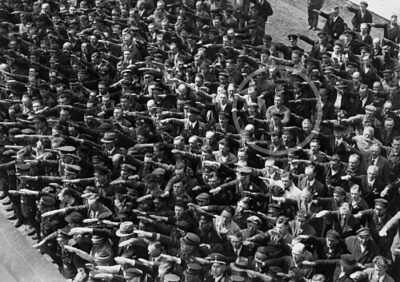
August Landmesser
August Landmesser was a German shipyard worker and anti-Nazi protester. Born May 24, 1910, in Moorrege. Died October 17, 1944, in Berlin.
Facts
7 facts · 2 confirmed by two sources · 2 cited · 3 from one source
Where this comes from
Papalocal keeps its own record. It started from these sources; what each one said is kept here as it was copied, so a change on their side never changes this page by itself. Tap one to read its version.
What Wikidata says · copied November 16, 2026 · revision 2569213535
- Described as
- German shipyard worker and anti-Nazi protester (1910–1944)
- Born
- May 24, 1910
- Died
- October 17, 1944
- Born in
- Moorrege · 1 reference
- Died in
- Berlin
- Citizen of
- German Reich
- Occupation
- laborer · 1 reference
- Political party
- Nazi Party (1931–1935)
- Wikipedias with a page
- 39
Wikidata item Q62936 (wikidata.org/wiki/Q62936), public domain (CC0). Copied November 16, 2026.
What Wikipedia says · copied November 16, 2026 · revision 1380041733
August Landmesser (German: [ˈaʊ̯ɡʊst ˈlantˌmɛsɐ]; 24 May 1910 – 17 October 1944) was a German man who is suggested to be the man appearing in a 1936 photograph conspicuously refusing to perform the Nazi salute. Landmesser had run afoul of the Nazi Party over his unlawful relationship with Irma Eckler, a Jewish woman. For this, he was imprisoned and eventually drafted into penal military service, where he was killed in action.
Years after his death, his daughter suggested that he was the man in the famous photograph. However, the identity of the man in the photograph is not known with certainty—another family claims that the man is Gustav Wegert.
- Born, in its opening lines
- May 24, 1910
- Died, in its opening lines
- October 17, 1944
From the Wikipedia article “August Landmesser” (en.wikipedia.org/wiki/August_Landmesser), by its contributors, under CC BY-SA 4.0 (creativecommons.org/licenses/by-sa/4.0/). Copied November 16, 2026; not changed.
Confirmed Two sources agree. Cited One source, and it names where it got it. One source One source, without a reference of its own. Sources disagree The sources disagree. We show the best-supported value and keep theirs below.
