
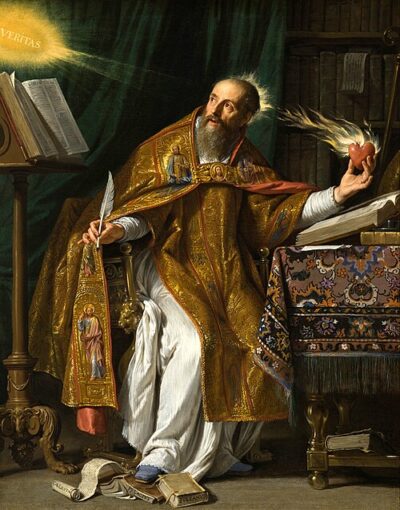
Augustine of Hippo
Augustine of Hippo was a Christian theologian, philosopher, and saint. Born November 13, 354, in Thagaste. Died August 28, 430, in Hippo Regius. Positions held include bishop of Hippo Regius (396–). Known for Confessions, The City of God and On the Trinity.
Facts
27 facts · 2 confirmed by two sources · 9 cited · 16 from one source
Where this comes from
Papalocal keeps its own record. It started from these sources; what each one said is kept here as it was copied, so a change on their side never changes this page by itself. Tap one to read its version.
What Wikidata says · copied November 16, 2026 · revision 2569269433
- Described as
- Christian theologian, philosopher, and saint (354–430)
- Other names
- Saint Austin, St Augustine, Saint Augustine, St Augustine of Hippo, Aurelius Augustinus, Saint Augustine of Hippo, Augustinus, Aurelius, Augustinus, Aurelius Augustine, Aurelius Augustinus Hipponensis, St. Augustine of Hippo, bishop of Hippo
- Born
- November 13, 354 · 1 reference
- Died
- August 28, 430 · 2 references
- Born in
- Thagaste · 1 reference
- Died in
- Hippo Regius
- Buried in
- San Pietro in Ciel d'Oro
- Citizen of
- Ancient Rome
- Occupation
- philosopher · 1 reference; theologian; autobiographer; music theorist; preacher; historian · 1 reference; poet · 2 references; writer · 4 references
- Positions held
- bishop of Hippo Regius (396–) · 1 reference
- Known for
- Confessions; The City of God; On the Trinity
- Field
- philosophy; theology
- Children
- Adeodatus
- Father
- Patricius · 1 reference
- Mother
- Monica of Hippo · 1 reference
- Siblings
- Perpetua of Hippo; Navigius of Hippo
- Religion
- Catholic Church · 1 reference; Manichaeism · 1 reference
- Wikipedias with a page
- 228
Wikidata item Q8018 (wikidata.org/wiki/Q8018), public domain (CC0). Copied November 16, 2026.
What Wikipedia says · copied November 16, 2026 · revision 1385568208
Augustine of Hippo ( aw-GUST-in, US also AW-gə-steen; Latin: Aurelius Augustinus Hipponensis; 13 November 354 – 28 August 430), also well-known as Saint Augustine, was a Christian theologian and philosopher from Thagaste, Numidia Cirtensis and the Bishop of Hippo Regius. He is generally regarded as one of the most influential philosophers in the history of the Western world, and is viewed as one of the most important Church Fathers of the Latin Church in the Patristic Period.
In his youth he was drawn to the Manichaean faith, and later to the Hellenistic philosophy of Neoplatonism. After his conversion to Christianity and baptism in 386 by Saint Ambrose, Augustine developed his own approach to philosophy and theology, making significant contributions in a wide variety of areas. He is known as Doctor Gratiae ("Doctor of Grace") for the vast influence of his views on the necessity of unmerited, prevenient grace, for salvation and the nature of original sin.
Additionally, he made important contributions in ecclesiology, noting the validity of sacraments regardless of the merit of the celebrant against the views of the Donatists. In his book The City of God, Augustine imagined the Church as a spiritual City, distinct from the material Earthly City, against the backdrop of the fall of the Western Roman Empire. He is also widely recognized for his contributions to just war theory. His other notable works include On the Trinity, On Christian Doctrine, and Confessions, the latter of which was the first Western autobiography.
Augustine is recognized as a saint in the Catholic Church, the Eastern Orthodox Church, the Lutheran churches, and the Anglican Communion. Generally regarded as one of the greatest theologians and philosophers in the history of the Catholic Church, he is one of the four Great Latin Church Fathers, along with Ambrose, Jerome, and Pope Gregory I. His thoughts profoundly influenced the Medieval worldview, and he was the most cited author in the Summa Theologiae of St. Thomas Aquinas. Many Protestants, especially Calvinists and Lutherans, consider him one of the theological fathers of the Protestant Reformation due to his teachings on salvation and divine grace, although this interpretation is disputed by the Catholic Church. In Eastern Orthodoxy, he remains highly venerated, but some of his teachings, including the filioque, are more disputed.
- Born, in its opening lines
- November 13, 354
- Died, in its opening lines
- August 28, 430
From the Wikipedia article “Augustine of Hippo” (en.wikipedia.org/wiki/Augustine_of_Hippo), by its contributors, under CC BY-SA 4.0 (creativecommons.org/licenses/by-sa/4.0/). Copied November 16, 2026; not changed.
Confirmed Two sources agree. Cited One source, and it names where it got it. One source One source, without a reference of its own. Sources disagree The sources disagree. We show the best-supported value and keep theirs below.
