
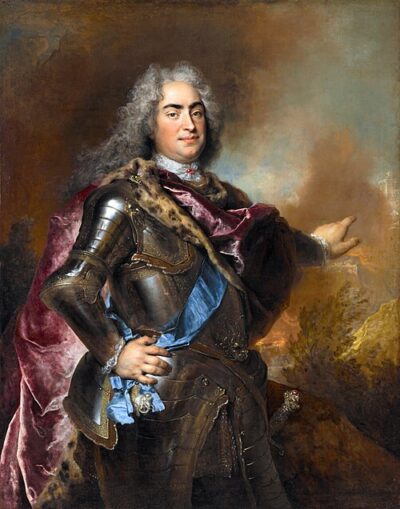
Augustus II the Strong
Augustus II the Strong was a King of Poland, Grand Duke of Lithuania and Elector of Saxony. Born May 12, 1670, in Dresden. Died February 1, 1733, in Warsaw. Positions held include Prince-Elector of Saxony (1694–1733) and King of Poland (2 times) (1697–1733). Awards include Knight of the Order of the Golden Fleece, Knight of the Order of St. Alexander Nevsky and Order of the White Eagle (Polish–Lithuanian Commonwealth).
Facts
36 facts · 2 confirmed by two sources · 8 cited · 26 from one source
Where this comes from
Papalocal keeps its own record. It started from these sources; what each one said is kept here as it was copied, so a change on their side never changes this page by itself. Tap one to read its version.
What Wikidata says · copied November 16, 2026 · revision 2568894515
- Described as
- King of Poland, Grand Duke of Lithuania and Elector of Saxony (1670–1733)
- Other names
- Hercules saxonicus, August II Mocny, Augustus the Strong, Augustus II, Augusto II el Fuerte, August the Strong
- Born
- May 12, 1670 · 10 references
- Died
- February 1, 1733 · 12 references
- Born in
- Dresden · 4 references
- Died in
- Warsaw · 4 references
- Buried in
- Wawel Cathedral
- Cause of death
- gangrene
- Citizen of
- Electorate of Saxony; Polish–Lithuanian Commonwealth
- Occupation
- art collector · 1 reference; politician · 1 reference; aristocrat · 1 reference; king · 1 reference
- Positions held
- Prince-Elector of Saxony (1694–1733) · 2 references; King of Poland (2 times) (1697–1733) · 1 reference
- Awards
- Knight of the Order of the Golden Fleece (1697); Knight of the Order of St. Alexander Nevsky (1725); Order of the White Eagle (Polish–Lithuanian Commonwealth) (1703); Order of the Black Eagle (1728); Order of St. Andrew (1712); Knight of the Order of the Elephant (1686)
- Field
- politics · 1 reference
- Spouse
- Christiane Eberhardine of Brandenburg-Bayreuth (1693–1727) · 1 reference
- Children
- Augustus III of Poland; Maurice de Saxe; Johann Georg, Chevalier de Saxe; Frederick Augustus Rutowsky; Maria Anna Katharina Rutowska · 1 reference; Anna Karolina Orzelska; Friederike Alexandrine Moszyńska; Friedrich August Cosel; Augusta Constantia von Friesen
- Father
- John George III of Saxony · 1 reference
- Mother
- Princess Anna Sophie of Denmark · 1 reference
- Siblings
- John George IV, Elector of Saxony; Johann Georg Maximilian Fürstenhoff
- Religion
- Lutheranism
- Wikipedias with a page
- 62
Wikidata item Q53437 (wikidata.org/wiki/Q53437), public domain (CC0). Copied November 16, 2026.
What Wikipedia says · copied November 16, 2026 · revision 1358616832
Augustus II the Strong (12 May 1670 – 1 February 1733), was Elector of Saxony as Frederick Augustus I (German: Friedrich August I) from 1694 as well as King of Poland and Grand Duke of Lithuania from 1697 to 1706 and from 1709 until his death in 1733. He belonged to the Albertine branch of the House of Wettin.
Augustus' great physical strength earned him the nicknames "the Strong", "the Saxon Hercules" and "Iron-Hand". He liked to show that he lived up to his name by breaking horseshoes with his bare hands and engaging in fox tossing by holding the end of his sling with just one finger while two of the strongest men in his court held the other end. He is also notable for fathering a very large number of children, with contemporary sources claiming a total of between 360 and 380.
In order to be elected king of the Polish–Lithuanian Commonwealth, Augustus converted to Catholicism. As a Catholic, he received the Order of the Golden Fleece from the Holy Roman Emperor and established the Order of the White Eagle, Poland's highest distinction. As elector of Saxony, he is perhaps best remembered as a patron of the arts and architecture. He transformed the Saxon capital of Dresden into a major cultural centre, attracting artists from across Europe to his court. Augustus also amassed an impressive art collection and built lavish baroque palaces in Dresden and Warsaw. In 1711, he served as the Imperial vicar of the Holy Roman Empire.
His reign brought about many troubles to Poland. He led the Polish–Lithuanian Commonwealth in the Great Northern War, which allowed the Russian Empire to strengthen its influence in Europe, especially within Poland. His main pursuit was bolstering royal power in the Commonwealth, characterised by broad decentralisation in comparison with other European monarchies. In order to reduce the autonomy of the Commonwealth's subjects, he used foreign powers, leading to the destabilisation of the country. Augustus ruled Poland with a 3-year interruption between 1706 and 1709; in 1704, the Swedes installed nobleman Stanisław Leszczyński as king, who officially reigned from 1706 to 1709 and then after Augustus' death in 1733, which sparked the War of the Polish Succession.
Augustus' body was buried in Poland's royal Wawel Cathedral in Kraków, but his heart rests in the Dresden Cathedral. His only legitimate son, Augustus III of Poland, became king in 1733.
- Born, in its opening lines
- May 12, 1670
- Died, in its opening lines
- February 1, 1733
From the Wikipedia article “Augustus II the Strong” (en.wikipedia.org/wiki/Augustus_II_the_Strong), by its contributors, under CC BY-SA 4.0 (creativecommons.org/licenses/by-sa/4.0/). Copied November 16, 2026; not changed.
Confirmed Two sources agree. Cited One source, and it names where it got it. One source One source, without a reference of its own. Sources disagree The sources disagree. We show the best-supported value and keep theirs below.
