
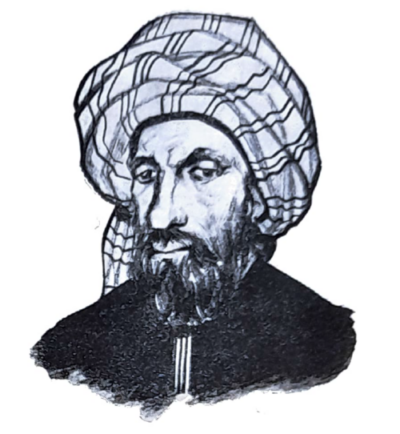
Avempace
Avempace was an Arab Andalusian polymath (c. 1085 – 1138). Born 1095, in Sarakusta. Died 1139, in Fez. Positions held include vizier.
Facts
22 facts · 0 confirmed by two sources · 10 cited · 9 from one source · 3 where the sources disagree
What’s different
- Born: we show 1095 (Sources disagree). Wikipedia says 1085
- Died: we show 1139 (Sources disagree). Wikipedia says 1138
- Born in: we show Sarakusta (Sources disagree). Wikidata also lists Zaragoza
Where this comes from
Papalocal keeps its own record. It started from these sources; what each one said is kept here as it was copied, so a change on their side never changes this page by itself. Tap one to read its version.
What Wikidata says · copied November 16, 2026 · revision 2563566934
- Described as
- Arab Andalusian polymath (c. 1085 – 1138)
- Other names
- Ibn Bâjja, Abenpace, Abempace
- Born
- 1095 · 1 reference
- Died
- 1139 · 3 references
- Born in
- Sarakusta · 1 reference; Zaragoza · 1 reference
- Died in
- Fez · 2 references
- Buried in
- Fez
- Citizen of
- Taifa of Zaragoza
- Occupation
- philosopher · 2 references; mathematician; astronomer; writer; physician; botanist; poet · 2 references; physicist · 1 reference
- Positions held
- vizier
- Field
- philosophy · 1 reference; Arab philosophy · 1 reference; astronomy · 1 reference; physics · 1 reference; medicine · 1 reference; botany · 1 reference
- Religion
- Islam
- Wikipedias with a page
- 57
Wikidata item Q11362 (wikidata.org/wiki/Q11362), public domain (CC0). Copied November 16, 2026.
What Wikipedia says · copied November 16, 2026 · revision 1382237514
Abū Bakr Muḥammad ibn Yaḥya ibn aṣ-Ṣā’igh at-Tūjībī ibn Bājja (Arabic: أبو بكر محمد بن يحيى بن الصائغ التجيبي بن باجة), known simply as Ibn Bajja (Arabic: ابن باجة) or his Latinized name Avempace (; c. 1085 – 1138), was an Arab polymath, whose writings include works regarding astronomy, physics, and music, as well as philosophy, medicine, botany, and poetry.
He was the author of the Kitāb an-Nabāt ("The Book of Plants"), a popular work on botany, which defined the sex of plants. His philosophical theories influenced the work of Ibn Rushd (Averroes) and Albertus Magnus. Most of his writings and books were not completed (or well-organized) due to his early death. He had a vast knowledge of medicine, mathematics, and astronomy. His main contribution to Islamic philosophy was his idea on soul phenomenology, which was never completed.
Avempace was, in his time, not only a prominent figure of philosophy but also of music and poetry. His diwan (Arabic: collection of poetry) was rediscovered in 1951. Though many of his works have not survived, his theories in astronomy and physics were preserved by Moses Maimonides and Averroes respectively, and influenced later astronomers and physicists in the Islamic civilization and Renaissance Europe, including Galileo Galilei.
Avempace wrote one of the first (argued by some to be the first) commentaries on Aristotle in the Western world. While his work on projectile motion was never translated from Arabic to Latin, his views became well known around the Western world and to Western philosophers, astronomers, and scientists of many disciplines. His works impacted contemporary medieval thought, and later influenced Galileo and his work. Avempace's theories on projectile motion are found in the text known as "Text 71".
- Born, in its opening lines
- 1085
- Died, in its opening lines
- 1138
From the Wikipedia article “Avempace” (en.wikipedia.org/wiki/Avempace), by its contributors, under CC BY-SA 4.0 (creativecommons.org/licenses/by-sa/4.0/). Copied November 16, 2026; not changed.
Confirmed Two sources agree. Cited One source, and it names where it got it. One source One source, without a reference of its own. Sources disagree The sources disagree. We show the best-supported value and keep theirs below.
