
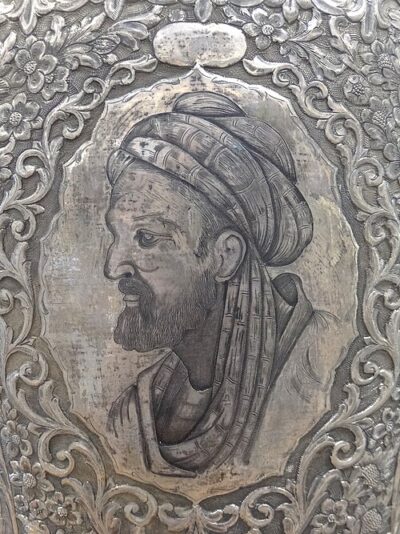
Avicenna
Avicenna was a Persian polymath, physician and philosopher (c. 980–1037). Born 980, in Afshona. Died June 18, 1037, in Hamadan. Positions held include vizier (1024–1037). Known for Canon of Medicine, The Book of Healing and Al-isharat wa al-tanbihat.
Facts
30 facts · 1 confirmed by two sources · 10 cited · 18 from one source · 1 where the sources disagree
What’s different
- Died: we show June 18, 1037 (Sources disagree). Wikipedia says June 22, 1037
Where this comes from
Papalocal keeps its own record. It started from these sources; what each one said is kept here as it was copied, so a change on their side never changes this page by itself. Tap one to read its version.
What Wikidata says · copied November 16, 2026 · revision 2567805922
- Described as
- Persian polymath, physician and philosopher (c. 980–1037)
- Other names
- Abitianus, Ibn Sīnā, Alraaʼys Ibn sīnā, Aboû Alî al-Hosain ibn Abdallâh ibn Sînâ, Pūr-i Sīnā, أبو علي الحسين بن عبد الله بن الحسن بن علي بن سينا
- Born
- 980 · 4 references; 980 · 1 reference
- Died
- June 18, 1037
- Born in
- Afshona · 2 references
- Died in
- Hamadan · 3 references
- Buried in
- Avicenna Mausoleum · 1 reference
- Name at birth
- أبو علي الحسين بن عبد الله بن الحسن بن علي بن سينا
- Occupation
- philosopher · 2 references; poet; astronomer · 2 references; physician · 4 references; music theorist; physicist · 3 references; mathematician · 2 references; chemist · 3 references
- Positions held
- vizier (1024–1037)
- Known for
- Canon of Medicine; The Book of Healing; Al-isharat wa al-tanbihat
- Field
- medicine; aromatherapy; philosophy; logic; Ilm al-Kalam; poetry
- Religion
- Islam · 1 reference
- Lived in
- Ray; Bukhara; Urgench; Gorgan; Hamadan
- Wikipedias with a page
- 194
Wikidata item Q8011 (wikidata.org/wiki/Q8011), public domain (CC0). Copied November 16, 2026.
What Wikipedia says · copied November 16, 2026 · revision 1384501058
Ibn Sina (c. 980 – 22 June 1037), commonly known in the West as Avicenna, was a preeminent philosopher and physician of the Muslim world. He was a seminal figure of the Islamic Golden Age, serving in the courts of various Iranian rulers, and was influential to medieval European medical and Scholastic thought. Avicenna is considered one of the greatest thinkers and medical scholars in history.
Often described as the father of early modern medicine, Avicenna's most famous works are The Book of Healing, a philosophical and scientific encyclopedia, and The Canon of Medicine, a medical encyclopedia that became a standard medical text at many medieval European universities and remained in use as late as 1650.
Besides philosophy and medicine, Avicenna's corpus includes writings on astronomy, alchemy, geography and geology, psychology, Islamic theology, logic, mathematics, physics, and works of poetry. His philosophy was of the Peripatetic school derived from Aristotelianism, of which he is considered among the greatest proponents within the Muslim world.
Avicenna wrote most of his philosophical and scientific works in Arabic but also wrote several key works in Persian; his poetry was written in both languages. Of the 450 works he is believed to have written, around 240 have survived, including 150 on philosophy and 40 on medicine.
Avicenna is also known for his unique methodological approach to his works. He combines a unique blend of empirical observation, philosophical reasoning, and logical analysis, in order to conduct his analysis and reach his conclusions. This is especially the case in his medical works, namely The Canon of Medicine.
- Born, in its opening lines
- c. 980
- Died, in its opening lines
- June 22, 1037
From the Wikipedia article “Avicenna” (en.wikipedia.org/wiki/Avicenna), by its contributors, under CC BY-SA 4.0 (creativecommons.org/licenses/by-sa/4.0/). Copied November 16, 2026; not changed.
Confirmed Two sources agree. Cited One source, and it names where it got it. One source One source, without a reference of its own. Sources disagree The sources disagree. We show the best-supported value and keep theirs below.
