
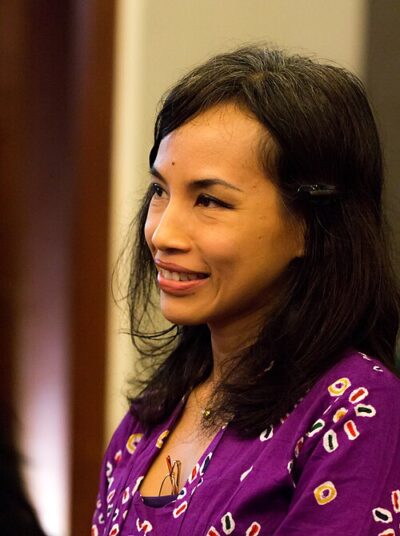
Ayu Utami
Ayu Utami is an Indonesian writer. Born November 21, 1968, in Bogor. Known for Saman. Educated at University of Indonesia. Awards include Prince Claus Award, Cultural Council of Jakarta and Kusala Sastra Khatulistiwa.
Facts
16 facts · 0 confirmed by two sources · 3 cited · 13 from one source
Where this comes from
Papalocal keeps its own record. It started from these sources; what each one said is kept here as it was copied, so a change on their side never changes this page by itself. Tap one to read its version.
What Wikidata says · copied November 18, 2026 · revision 2567127656
- Described as
- Indonesian writer
- Other names
- Juliana Ayu Utami
- Born
- November 21, 1968
- Born in
- Bogor · 1 reference
- Citizen of
- Indonesia · 1 reference
- Occupation
- journalist · 2 references; writer (1998–) · 1 reference; model · 1 reference; curator · 1 reference
- Education
- University of Indonesia (–1994) · 2 references
- Genre
- prose · 1 reference; essay · 1 reference
- Known for
- Saman · 1 reference
- Awards
- Prince Claus Award (2000) · 1 reference; Cultural Council of Jakarta (1998) · 1 reference; Kusala Sastra Khatulistiwa (2008) · 1 reference; Jakarta Arts Council Novel Competition · 1 reference
- Website
- http://www.ayuutami.info/
- Wikipedias with a page
- 23
Wikidata item Q1318953 (wikidata.org/wiki/Q1318953), public domain (CC0). Copied November 18, 2026.
What Wikipedia says · copied November 18, 2026 · revision 1377358832
Ayu Utami is an Indonesian writer who has written novels, short-stories, and articles. Saman (1998) is widely considered her masterpiece. It was translated into English by Pamela Allen in 2005. By writing about sex and politics, Utami addressed issues formerly forbidden to Indonesian women, a change referred to as sastra wangi.
From the Wikipedia article “Ayu Utami” (en.wikipedia.org/wiki/Ayu_Utami), by its contributors, under CC BY-SA 4.0 (creativecommons.org/licenses/by-sa/4.0/). Copied November 18, 2026; not changed.
Confirmed Two sources agree. Cited One source, and it names where it got it. One source One source, without a reference of its own. Sources disagree The sources disagree. We show the best-supported value and keep theirs below.
