
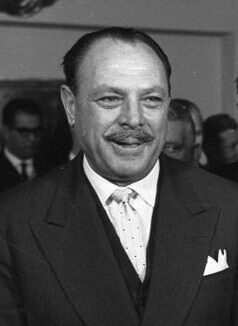
Ayub Khan
Ayub Khan was a President of Pakistan from 1958 to 1969. Born May 14, 1907, in Rehana. Died April 19, 1974, in Rawalpindi. Positions held include President of Pakistan (1958–1969), Federal Minister for Defence (2 times) (1954–1966) and Commander in Chief (Pakistan Army) (1951–1958). Educated at Aligarh Muslim University and Royal Military College, Sandhurst. Awards include Member of the Order of the British Empire, Knight Grand Cross of the Order of St Michael and St George and Royal Victorian Chain.
Facts
36 facts · 2 confirmed by two sources · 0 cited · 34 from one source
Where this comes from
Papalocal keeps its own record. It started from these sources; what each one said is kept here as it was copied, so a change on their side never changes this page by itself. Tap one to read its version.
What Wikidata says · copied November 16, 2026 · revision 2568864521
- Described as
- President of Pakistan from 1958 to 1969
- Other names
- Muhammad Ayub Khan
- Born
- May 14, 1907 · 7 references
- Died
- April 19, 1974 · 5 references
- Born in
- Rehana
- Died in
- Rawalpindi
- Buried in
- Rehana · 1 reference
- Cause of death
- cardiac arrest
- Citizen of
- British Raj; Pakistan
- Occupation
- politician; military personnel; financier · 1 reference; autobiographer · 1 reference
- Positions held
- President of Pakistan (1958–1969); Federal Minister for Defence (2 times) (1954–1966); Commander in Chief (Pakistan Army) (1951–1958); Prime Minister of Pakistan (1958); Federal Minister for Interior (1965) · 1 reference
- Political party
- Pakistan Muslim League
- Education
- Aligarh Muslim University; Royal Military College, Sandhurst; Command and Staff College; Minto Circle
- Awards
- Member of the Order of the British Empire; Knight Grand Cross of the Order of St Michael and St George; Royal Victorian Chain (1966); Order of Ojaswi Rajanya; Grand Cross of the Order of Excellence · 1 reference; 1939–45 Star · 1 reference; War Medal 1939–1945 · 1 reference; Burma Star · 1 reference; Queen Elizabeth II Coronation Medal · 1 reference
- Children
- Gohar Ayub Khan
- Religion
- Islam; Shia Islam
- Military branch
- British Indian Army · 1 reference
- Military rank
- Field marshal · 1 reference
- Wikipedias with a page
- 68
Wikidata item Q190071 (wikidata.org/wiki/Q190071), public domain (CC0). Copied November 16, 2026.
What Wikipedia says · copied November 16, 2026 · revision 1385678571
Field Marshal Mohammad Ayub Khan NPk HJ HPk MBE (14 May 1907 – 19 April 1974) was a Pakistani politician and military officer who served as the 2nd president of Pakistan from 1958 until his resignation in 1969. He was the first native commander-in-chief of the Pakistan Army, serving from 1951 to 1958. Khan's presidency started in 1958 when he overthrew President Iskander Mirza in a coup d'état, and ended in 1969 when he resigned amid mass protests and strikes across the country.
Born in the North-West Frontier Province, Khan was educated at the Aligarh Muslim University and trained at the Royal Military College, Sandhurst. He fought in the Second World War on the British side against the Imperial Japanese Army. After the Partition of British India in August 1947, he joined the Pakistan Army and was posted in East Bengal. In 1951, he became the first native commander-in-chief, succeeding General Gracey. From 1953 to 1958, he served in the civilian government as Defence and Home Minister and supported President Iskandar Ali Mirza's decision to impose martial law against prime minister Feroz Khan Noon's administration on 7 October 1958. Three weeks later, Ayub Khan seized the presidency in a military coup, the first in the country's history.
As president, Khan appointed General Musa Khan to replace him as Commander-in-Chief of the Pakistan Army, who served as Army Chief for 8 years under President Khan. He aligned Pakistan with the United States, and allowed American access to air bases inside Pakistan, most notably the airbase outside of Peshawar, from which spy missions over the Soviet Union were launched. Relations with neighboring China were strengthened, but his alignment with the US worsened relations with the Soviet Union in 1962. He launched Operation Gibraltar against India in 1965, leading to an all-out war. It resulted in a stalemate, and peace was restored via the Tashkent Declaration. Domestically, Ayub subscribed to the laissez-faire policy of Western-aligned nations at the time. Ayub Khan privatised state-owned industries and liberalised the economy generally. Large inflows of foreign aid and investment led to the fastest-growing economy in South Asia. His tenure was also distinguished by the completion of hydroelectric stations, dams, and reservoirs. Under Khan, Pakistan's space program was established, and the country launched its first uncrewed space mission by 1962. However, the failure of land reforms and a weak taxation system meant that most of this growth landed in the hands of the elite. In 1965, Khan entered the presidential race as the Convention Muslim League's candidate to counter the opposition candidate Fatima Jinnah. Khan won the elections and was re-elected for a second term. In 1967, disapproval of price hikes of food prompted demonstrations across the country led by Zulfikar Ali Bhutto. Following the protests in East Pakistan, Khan resigned on 25 March 1969 and appointed General Yahya Khan as his successor. Later, fighting a brief illness, he died in 1974.
Ayub Khan remains the country's longest-serving president and second-longest serving head of state. His legacy remains mixed; his era is often referred to as the "Decade of Development." Khan is credited with economic prosperity and industrialisation. He is denounced by critics for beginning the first of the intelligence agencies' incursions into national politics, for concentrating wealth in a corrupt few hands, and for geographically discriminatory policies that later led to the Bangladesh Liberation War.
- Born, in its opening lines
- May 14, 1907
- Died, in its opening lines
- April 19, 1974
From the Wikipedia article “Ayub Khan” (en.wikipedia.org/wiki/Ayub_Khan), by its contributors, under CC BY-SA 4.0 (creativecommons.org/licenses/by-sa/4.0/). Copied November 16, 2026; not changed.
Confirmed Two sources agree. Cited One source, and it names where it got it. One source One source, without a reference of its own. Sources disagree The sources disagree. We show the best-supported value and keep theirs below.
