
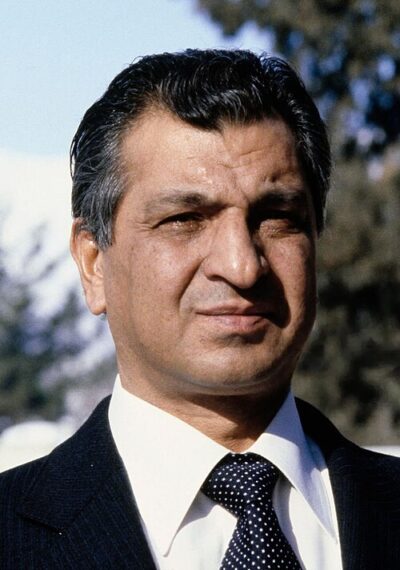
Babrak Karmal
Babrak Karmal was the 3rd General Secretary of the People's Democratic Party of Afghanistan. Born January 6, 1929, in Kabul. Died December 3, 1996, in Moscow. Positions held include Chairman of the Revolutionary Council of Afghanistan (1979–1986) and Prime Minister of Afghanistan (1979–1981). Educated at Kabul University. Awards include Order of the Saur Revolution.
Facts
17 facts · 1 confirmed by two sources · 2 cited · 14 from one source
Where this comes from
Papalocal keeps its own record. It started from these sources; what each one said is kept here as it was copied, so a change on their side never changes this page by itself. Tap one to read its version.
What Wikidata says · copied November 16, 2026 · revision 2568914460
- Described as
- 3rd General Secretary of the People's Democratic Party of Afghanistan (1929–1996)
- Other names
- Karmal
- Born
- January 6, 1929 · 4 references
- Died
- December 3, 1996 · 4 references
- Born in
- Kabul
- Died in
- Moscow · 1 reference
- Buried in
- Hairatan · 1 reference
- Cause of death
- liver cancer
- Citizen of
- Kingdom of Afghanistan; Republic of Afghanistan
- Occupation
- politician; diplomat; lawyer
- Positions held
- Chairman of the Revolutionary Council of Afghanistan (1979–1986); Prime Minister of Afghanistan (1979–1981)
- Political party
- People’s Democratic Party of Afghanistan
- Education
- Kabul University
- Awards
- Order of the Saur Revolution
- Religion
- atheism
- Wikipedias with a page
- 53
Wikidata item Q63827 (wikidata.org/wiki/Q63827), public domain (CC0). Copied November 16, 2026.
What Wikipedia says · copied November 16, 2026 · revision 1385557719
Babrak Karmal (born Sultan Hussein; 6 January 1929 – 1 or 3 December 1996) was an Afghan communist revolutionary and politician who was the leader of Afghanistan, serving in the post of general secretary of the People's Democratic Party of Afghanistan from 1979 to 1986.
Kārmal attended Kabul University and developed openly leftist views there, having been introduced to Marxism by Mir Akbar Khyber during his imprisonment for activities deemed too radical by the government. He became a founding member of the People's Democratic Party of Afghanistan (PDPA) and eventually became the leader of the Parcham faction when the PDPA split in 1967, with their ideological nemesis being the Khalq faction. Kārmal was elected to the Lower House after the 1965 parliamentary election, serving in parliament until losing his seat in the 1969 parliamentary election.
Under Kārmal's leadership, the Parchamite PDPA participated in Mohammad Daoud Khan's rise to power in 1973, and his subsequent regime. While relations were good at the beginning, Daoud began a major purge of leftist influence in the mid-1970s. This in turn led to the reformation of the PDPA in 1977, and Kārmal played a role in the 1978 Saur Revolution when the PDPA took power. Kārmal was appointed Deputy Chairman of the Revolutionary Council, synonymous with vice head of state, in the communist government. The Parchamite faction found itself under significant pressure by the Khalqists soon after taking power. In June 1978, a PDPA Central Committee meeting voted in favor of giving the Khalqist faction exclusive control over PDPA policy. This decision was followed by a failed Parchamite coup, after which Hafizullah Amin, a Khalqist, initiated a purge against the Parchamites. Kārmal survived this purge but was exiled to Prague and eventually dismissed from his post. Instead of returning to Kabul, he feared for his life and lived with his family in the forests protected by the Czechoslovak secret police StB. The Afghan secret police KHAD had allegedly sent members to Czechoslovakia to assassinate Kārmal. In late 1979 he was brought to Moscow by the KGB and eventually, in December 1979, the Soviet Union intervened in Afghanistan (with the consent of Amin's government) to stabilize the country. The Soviet troops staged a coup and assassinated Amin, replacing him with Kārmal.
Kārmal was promoted to Chairman of the Revolutionary Council and Chairman of the Council of Ministers in December 1979. He remained in the latter office until 1981, when he was succeeded by Sultan Ali Keshtmand. Throughout his term, Kārmal worked to establish a support base for the PDPA by introducing several reforms. Among these were the "Fundamental Principles of the Democratic Republic of Afghanistan", introducing a general amnesty for those people imprisoned during Nur Mohammad Taraki's and Amin's rule. He also replaced the red Khalqist flag with a more traditional one. These policies failed to increase the PDPA's legitimacy in the eyes of the Afghan people and the Afghan mujahidin rebels, and he was widely seen as a Soviet puppet amongst the populace. These policy failures, and the stalemate that ensued after the Soviet intervention, led the Soviet leadership to become highly critical of Kārmal's leadership. Under Mikhail Gorbachev, the Soviet Union deposed Kārmal in 1986 and replaced him with Mohammad Najibullah. After losing power, he was exiled to Moscow. It was Anahita Ratebzad who persuaded Najibullah to allow Babrak Kārmal to return to Afghanistan in 1991, where Kārmal became an associate of Abdul Rashid Dostum and possibly helped remove the Najibullah government from power in 1992. He eventually left Afghanistan again for Moscow. In 1996, Kārmal died from liver cancer.
- Born, in its opening lines
- January 6, 1929
From the Wikipedia article “Babrak Karmal” (en.wikipedia.org/wiki/Babrak_Karmal), by its contributors, under CC BY-SA 4.0 (creativecommons.org/licenses/by-sa/4.0/). Copied November 16, 2026; not changed.
Confirmed Two sources agree. Cited One source, and it names where it got it. One source One source, without a reference of its own. Sources disagree The sources disagree. We show the best-supported value and keep theirs below.
