
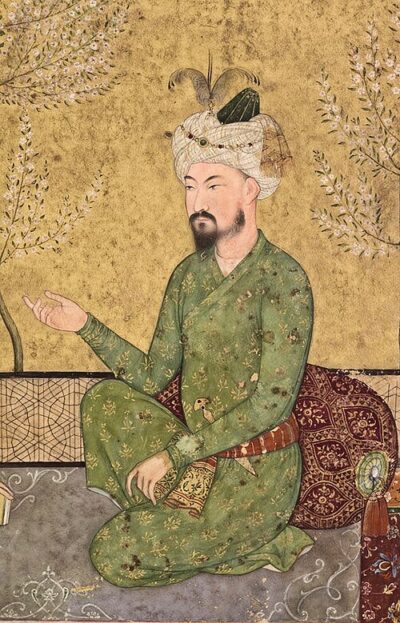
Babur
Babur was a founder of the Mughal Empire. Born February 14, 1483, in Andijan. Died December 26, 1530, in Agra. Positions held include Mughal emperor (1526–1530). Known for Baburnama.
Facts
30 facts · 2 confirmed by two sources · 2 cited · 26 from one source
Where this comes from
Papalocal keeps its own record. It started from these sources; what each one said is kept here as it was copied, so a change on their side never changes this page by itself. Tap one to read its version.
What Wikidata says · copied November 16, 2026 · revision 2559776790
- Described as
- founder of the Mughal Empire (1526–1530)
- Other names
- Zahīr ud-Dīn Muhammad Bābur, Zahir-ud-din Muhammad, Baber, Ẓahīr al-Dīn, Emperor of Hindustan Muḥammad Bābar, Zahir al-Din Muhammad, Babar, Firdaws Makani
- Born
- February 14, 1483 · 3 references
- Died
- December 26, 1530 · 1 reference
- Born in
- Andijan
- Died in
- Agra · 1 reference
- Buried in
- Gardens of Babur · 1 reference
- Occupation
- poet; autobiographer; monarch · 1 reference; writer · 1 reference
- Positions held
- Mughal emperor (1526–1530)
- Known for
- Baburnama
- Spouse
- Aisha Sultan Begum (1499–1503); Mubarika Yusufzai; Maham Begum; Masuma Sultan Begum · 1 reference; Zainab Sultan Begum
- Children
- Mirza Hindal; Gulbadan Begum; Humayun; Kamran Mirza; Askari Mirza; Fakhr-un-Nissa; Gulchehra Begum; Altun Bishik; Masuma Sultan Begum · 1 reference; Gulrukh Begum
- Father
- Umar Shaikh Mirza II
- Mother
- Qutlugh Nigar Khanum
- Siblings
- Khanzada Begum · 1 reference
- Religion
- Islam · 1 reference
- Wikipedias with a page
- 108
Wikidata item Q797848 (wikidata.org/wiki/Q797848), public domain (CC0). Copied November 16, 2026.
What Wikipedia says · copied November 16, 2026 · revision 1385694686
Babur (Persian: ببر, Persian: [bɑː.βuɾ]; 14 February 1483 – 26 December 1530; born Zahīr ud-Dīn Muhammad) was the founder of the Mughal Empire in South Asia. He was a descendant of Timur and Genghis Khan through his father and mother, respectively. He was also given the posthumous name of Firdaws Makani ('Dwelling in Paradise').
Born in Andijan in the Fergana Valley (now in Uzbekistan), Babur was the eldest son of Umar Shaikh Mirza II (1456–1494, Timurid governor of Fergana from 1469 to 1494) and a great-great-great-grandson of Timur (1336–1405). He ascended the throne of Fergana in its capital, Akhsikath, in 1494 at the age of twelve and had to put down a rebellion. He conquered Samarkand two years later, only to lose Fergana soon after. In his attempt to reconquer Fergana, he lost control of Samarkand as well. In 1501, he briefly recaptured both areas but his attempt failed when the Uzbek prince Muhammad Shaybani defeated him and founded the Khanate of Bukhara.
In 1504, the exiled Babur conquered Kabul, which was under the putative rule of Abd ur-Razaq Mirza, the infant heir of his uncle Ulugh Beg II. Forming a partnership with the Safavid emperor Ismail I he reconquered parts of Turkestan in 1511, including Samarkand, only to again lose it and the other newly conquered lands to the Shaybanids.
After losing Samarkand for the third time, Babur turned his attention to India and employed aid from the neighbouring Safavid and Ottoman empires. He defeated Ibrahim Lodi, the Sultan of Delhi, at the First Battle of Panipat in 1526 and founded the Mughal Empire. Before the defeat of Lodi at Panipat, the Sultanate of Delhi had been a spent force, long in a state of decline.
The ruler of the adjacent Kingdom of Mewar, Rana Sanga, advanced on Babur with a grand coalition of Rajput and Afghan warlords, engaging Babur in the Battle of Khanwa. Babur achieved a decisive victory due to his skillful troop positioning and use of gunpowder. The battle, one of the most decisive events in Indian history, was a watershed event in the Mughal conquest of northern India.
Religiously, Babur started his life as a staunch Sunni Muslim, but he underwent significant evolution. He became more tolerant as he conquered new territories and grew older, allowing other religions to peacefully coexist in his empire and at his court. He also displayed a certain attraction to theology, poetry, geography, history, and biology — disciplines he promoted at his court — earning him a frequent association with representatives of the Timurid Renaissance. His religious and philosophical stances are characterized as humanistic.
Babur married several times. Notable among his children were Humayun, Kamran Mirza, Hindal Mirza, Masuma Sultan Begum, and the author Gulbadan Begum. Babur died in 1530 in Agra, with Humayun succeeding him. He was first buried in Agra, but, as per his wishes, his remains were moved to Kabul and reburied. Babur is regarded as a national hero in Uzbekistan and Kyrgyzstan. He wrote the Baburnama in Chaghatai Turkic; it was translated into Persian during the reign (1556–1605) of his grandson, the emperor Akbar. Many of his poems have become popular folk songs. A devoted garden-builder, Babur is also credited with introducing the formal charbagh to the plains of northern India.
- Born, in its opening lines
- February 14, 1483
- Died, in its opening lines
- December 26, 1530
From the Wikipedia article “Babur” (en.wikipedia.org/wiki/Babur), by its contributors, under CC BY-SA 4.0 (creativecommons.org/licenses/by-sa/4.0/). Copied November 16, 2026; not changed.
Confirmed Two sources agree. Cited One source, and it names where it got it. One source One source, without a reference of its own. Sources disagree The sources disagree. We show the best-supported value and keep theirs below.
