
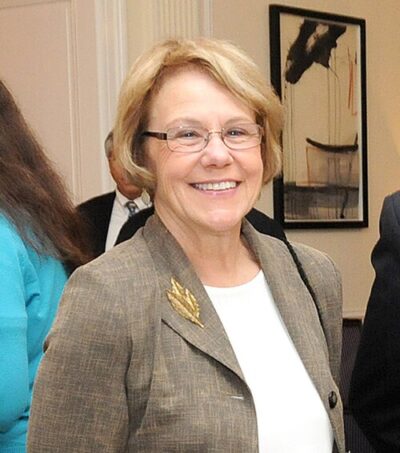
Barbara A. Schaal
Barbara A. Schaal is a German biologist. Born 1947, in Berlin. Educated at Yale University and University of Illinois Chicago. Awards include Guggenheim Fellowship and Wilbur Cross Medal.
Facts
12 facts · 0 confirmed by two sources · 6 cited · 6 from one source
Where this comes from
Papalocal keeps its own record. It started from these sources; what each one said is kept here as it was copied, so a change on their side never changes this page by itself. Tap one to read its version.
What Wikidata says · copied November 19, 2026 · revision 2520177644
- Described as
- German biologist
- Other names
- Barbara Anna Schaal, Barbara Schaal
- Born
- 1947
- Born in
- Berlin
- Citizen of
- United States (1956–) · 1 reference
- Occupation
- biologist
- Worked for
- Washington University in St. Louis
- Education
- Yale University (–1974) · 1 reference; University of Illinois Chicago
- Member of
- National Academy of Sciences (1999–) · 1 reference; American Academy of Arts and Sciences; United States President's Council of Advisors on Science and Technology · 1 reference
- Awards
- Guggenheim Fellowship (1997) · 1 reference; Wilbur Cross Medal (2004) · 1 reference
- Wikipedias with a page
- 13
Wikidata item Q4795237 (wikidata.org/wiki/Q4795237), public domain (CC0). Copied November 19, 2026.
What Wikipedia says · copied November 19, 2026 · revision 1375560213
Barbara Anna Schaal (born 1947 in Berlin, Germany, naturalized in 1956) is a German-born American professor, scientist, and evolutionary biologist at Washington University in St. Louis and served as vice president of the National Academy of Sciences from 2005 to 2013. She is the first woman to be elected vice president of the academy. From 2009 to 2017, Schaal served on the President's Council of Advisors on Science and Technology (PCAST).
From the Wikipedia article “Barbara A. Schaal” (en.wikipedia.org/wiki/Barbara_A._Schaal), by its contributors, under CC BY-SA 4.0 (creativecommons.org/licenses/by-sa/4.0/). Copied November 19, 2026; not changed.
Confirmed Two sources agree. Cited One source, and it names where it got it. One source One source, without a reference of its own. Sources disagree The sources disagree. We show the best-supported value and keep theirs below.
