
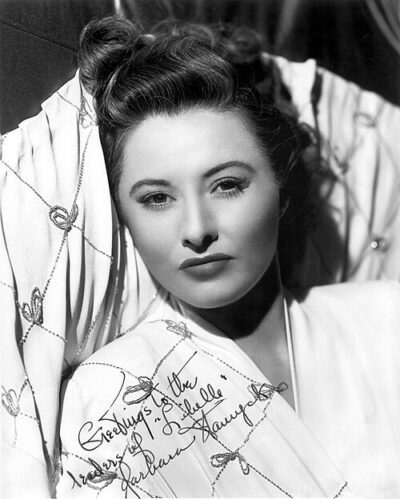
Barbara Stanwyck
Barbara Stanwyck was an American actress. Born July 16, 1907, in Brooklyn. Died January 20, 1990, in Santa Monica. Educated at Erasmus Hall High School. Awards include SAG-AFTRA Life Achievement Award, AFI Life Achievement Award and Primetime Emmy Award for Outstanding Lead Actress in a Drama Series.
Facts
31 facts · 2 confirmed by two sources · 7 cited · 21 from one source · 1 where the sources disagree
What’s different
- Cause of death: we show pulmonary emphysema (Sources disagree). Wikidata also lists heart failure
Where this comes from
Papalocal keeps its own record. It started from these sources; what each one said is kept here as it was copied, so a change on their side never changes this page by itself. Tap one to read its version.
What Wikidata says · copied November 13, 2026 · revision 2567365759
- Described as
- American actress (1907–1990)
- Other names
- Ruby Catherine Stevens, Ruby Stevens
- Born
- July 16, 1907 · 14 references
- Died
- January 20, 1990 · 14 references
- Born in
- Brooklyn · 1 reference
- Died in
- Santa Monica · 2 references
- Buried in
- Lone Pine
- Cause of death
- pulmonary emphysema; heart failure
- Name at birth
- Ruby Catherine Stevens
- Citizen of
- United States
- Occupation
- television actor; film actor · 1 reference; model; dancer · 1 reference; stage actor; actor · 2 references; Ziegfeld girl; writer
- Political party
- Republican Party
- Education
- Erasmus Hall High School · 1 reference
- Genre
- Western film; film noir
- Awards
- SAG-AFTRA Life Achievement Award; AFI Life Achievement Award (1987); Primetime Emmy Award for Outstanding Lead Actress in a Drama Series (1966); Primetime Emmy Award for Outstanding Lead Actress in a Miniseries or a Movie (1983); star on Hollywood Walk of Fame · 1 reference; Academy Honorary Award (1982); Golden Globe Cecil B. DeMille Award (1986)
- Spouse
- Frank Fay (1928–1935); Robert Taylor (1939–1951)
- Father
- Byron Stevens · 1 reference
- Mother
- Catherine McPhee · 1 reference
- Wikipedias with a page
- 85
Wikidata item Q94002 (wikidata.org/wiki/Q94002), public domain (CC0). Copied November 13, 2026.
What Wikipedia says · copied November 13, 2026 · revision 1383094901
Barbara Stanwyck (; born Ruby Catherine Stevens; July 16, 1907 – January 20, 1990) was an American actress and dancer. A stage, film, and television star, during her 60-year professional career she was known for her strong, realistic screen presence and versatility. She was a favorite of directors, including Cecil B. DeMille, Fritz Lang, and Frank Capra, and made 86 films in 38 years before turning to television. She received numerous accolades, including three Primetime Emmy Awards and a Golden Globe Award, and was nominated for four Academy Awards.
Orphaned at the age of four and partially raised in foster homes, she always worked. One of her directors, Jacques Tourneur, said of her, "She only lives for two things, and both of them are work." She made her debut on stage in the chorus as a Ziegfeld girl in 1923 at age 16, and within a few years was acting in plays. Her first lead role, which was in the hit Burlesque (1927), established her as a Broadway star. In 1929 she transitioned from the stage to the film industry and began acting in talking pictures, the first of which was George Archainbaud's The Locked Door, where her naturalistic acting style and unaffected vocal delivery were instantly evident. Frank Capra chose her for his romantic drama Ladies of Leisure (1930), and Stanwyck later became a favorite of Capra’s, leading to another three collaborations. This led to additional leading roles which raised her profile, such as Night Nurse (1931), Baby Face (1933), the controversial The Bitter Tea of General Yen (1933), and Gambling Lady (1934).
By the late 1930s, Stanwyck had moved to more mature roles in critically and commercially successful comedies and dramas. For her performance as the titular character in Stella Dallas (1937), she earned her first Academy Award nomination for Best Actress. In 1941, she starred in two screwball comedies: Ball of Fire with Gary Cooper, and The Lady Eve with Henry Fonda. She received her second Academy Award nomination for Ball of Fire, and in the decades since its release, The Lady Eve has come to be regarded as a comedic classic, with Stanwyck's performance widely hailed as one of the best in American comedy. Other successful films during this period are Remember the Night (1940), Meet John Doe (1941) and You Belong to Me (1941), reteaming her with Cooper and Fonda, respectively, The Gay Sisters (1942), and Lady of Burlesque (1943).
By 1944, Stanwyck had become the highest-paid actress in the United States. That year she received a third Academy Award nomination for Best Actress in the film noir Double Indemnity, playing a wife who persuades an insurance salesman to kill her husband. In 1945 she played a homemaker columnist in the holiday classic Christmas in Connecticut, and the following year starred as the titular femme fatale in The Strange Love of Martha Ivers. For the remainder of the decade Stanwyck starred in additional successes, ranging from romantic dramas and comedies to suspenseful crime-noirs. Her films during this period include My Reputation (1946), The Two Mrs. Carrolls (1947), Sorry, Wrong Number (1948), for which she received her fourth and final Academy Award nomination, and East Side, West Side (1949). By the early 1950s, Stanwyck's career began to decline, despite a fair number of leading and major supporting roles, the most successful being Clash by Night (1952), Jeopardy (1953), and Executive Suite (1954). She starred in Samuel Fuller's western Forty Guns (1957) in the role of a mighty landowner.
In the 1960s, she made a successful transition to television, where she won three Emmy Awards, for The Barbara Stanwyck Show (1961), the Western series The Big Valley (1966), and the miniseries The Thorn Birds (1983).
She received an Honorary Oscar in 1982, the Golden Globe Cecil B. DeMille Award in 1986, and several other honorary lifetime awards. In 1999 she was ranked as the 11th-greatest female star of classic American cinema by the American Film Institute.
- Born, in its opening lines
- July 16, 1907
- Died, in its opening lines
- January 20, 1990
From the Wikipedia article “Barbara Stanwyck” (en.wikipedia.org/wiki/Barbara_Stanwyck), by its contributors, under CC BY-SA 4.0 (creativecommons.org/licenses/by-sa/4.0/). Copied November 13, 2026; not changed.
Confirmed Two sources agree. Cited One source, and it names where it got it. One source One source, without a reference of its own. Sources disagree The sources disagree. We show the best-supported value and keep theirs below.
