
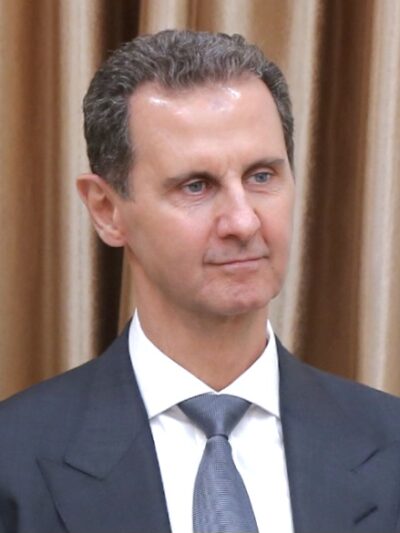
Bashar al-Assad
Bashar al-Assad is a Syrian convicted fugitive and former President of Syria from 2000 to 2024. Born September 11, 1965, in Qardaha District. Positions held include President of Syria (2000–2024) and commanding officer (2000–2024). Educated at Damascus University and Homs Military Academy. Awards include Grand Cross of the Legion of Honour, Order of Prince Yaroslav the Wise, 1st class and Royal Order of Francis I.
Facts
50 facts · 1 confirmed by two sources · 23 cited · 26 from one source
Where this comes from
Papalocal keeps its own record. It started from these sources; what each one said is kept here as it was copied, so a change on their side never changes this page by itself. Tap one to read its version.
What Wikidata says · copied November 16, 2026 · revision 2568000285
- Described as
- Syrian convicted fugitive and former President of Syria from 2000 to 2024
- Other names
- Bashshār, Bashar al Assad, Bashar Assad, Bashar Hafez al-Assad
- Born
- September 11, 1965 · 6 references
- Born in
- Qardaha District · 2 references
- Citizen of
- Syria · 2 references
- Occupation
- statesperson; ophthalmologist · 1 reference; military leader; politician · 1 reference; military physician · 1 reference; criminal · 1 reference; fugitive · 1 reference
- Positions held
- President of Syria (2000–2024) · 2 references; commanding officer (2000–2024) · 1 reference
- Political party
- Arab Socialist Ba'ath Party – Syria Region
- Worked for
- Western Eye Hospital
- Education
- Damascus University (1982–1988); Homs Military Academy · 1 reference
- Awards
- Grand Cross of the Legion of Honour (2001–2018) · 2 references; Order of Prince Yaroslav the Wise, 1st class (2002) · 1 reference; Royal Order of Francis I (2004); Order of Zayed (2008) · 1 reference; Grand Cross with Collar of the Order of the White Rose of Finland (2009) · 1 reference; King Abdulaziz Medal · 1 reference; Knight Grand Cross with Collar of the Order of Merit of the Italian Republic (2010–2012) · 1 reference; Order of the Liberator (2010) · 1 reference; Grand Collar of the Order of the Southern Cross (2010) · 1 reference; Grand Cordon of the National Order of the Cedar (2010) · 1 reference; Order of Islamic Republic (2010) · 1 reference; Order of the Umayyads; Sacred Military Constantinian Order of Saint George · 1 reference; Order of Civil Merit of the Syrian Arab Republic · 1 reference; Order of Military Merit (Syria) · 1 reference
- Field
- politics · 1 reference; military administration · 1 reference
- Spouse
- Asma al-Assad (2000–) · 1 reference
- Children
- Hafez Bashar al-Assad; Zain al-Assad; Kareem al-Assad
- Father
- Hafez al-Assad · 1 reference
- Mother
- Anisa Makhlouf
- Siblings
- Bassel al-Assad; Maher al-Assad; Majd al-Assad; Bushra al-Assad
- Religion
- Alawites
- Military branch
- Syrian Arab Armed Forces; Syrian Army; Syrian Republican Guard
- Military rank
- marshal
- Lived in
- People's Palace, Damascus (1965–2024) · 2 references; Moscow (2024–) · 1 reference
- Wikipedias with a page
- 152
Wikidata item Q44329 (wikidata.org/wiki/Q44329), public domain (CC0). Copied November 16, 2026.
What Wikipedia says · copied November 16, 2026 · revision 1385460718
Bashar Hafez al-Assad (born 11 September 1965) is a Syrian former politician, medical doctor, military officer, and dictator who served as the president of Syria from 2000 until his overthrow in 2024 after the Syrian civil war. He is the son of Hafez al-Assad, who ruled Syria from 1970 to 2000. His rule as president was a highly personalist dictatorship that governed Syria as a totalitarian police state, becoming arguably more repressive than his father. In August 2026, Assad was convicted of war crimes and crimes against humanity by a Syrian court and sentenced to death in absentia.
In the 1980s, Assad became a doctor, and in the early 1990s he was training in London as an ophthalmologist. In 1994, after his elder brother Bassel al-Assad died in a car crash, Assad was recalled to Syria to take over Bassel's role as heir apparent. Assad entered the military academy and in 1998 took charge of the Syrian occupation of Lebanon begun by his father. On 17 July 2000, Assad became president, succeeding his father, who had died on 10 June 2000. Assad also became commander-in-chief of the Syrian Arab Armed Forces and secretary-general of the Central Command of the Arab Socialist Ba'ath Party. Hopes that the Western-educated Assad would bring reform to Syria and relax the occupation of Lebanon were dashed following a series of crackdowns in 2001–2002 that ended the Damascus Spring, a period defined by calls for transparency and democracy.
Assad's first decade in power was marked by extensive censorship, summary executions, forced disappearances, discrimination against ethnic minorities, and extensive surveillance by the Ba'athist secret police. While the Assad government described itself as secular, various political scientists and observers noted that his regime exploited sectarian tensions in the country. Although Assad inherited Hafez's power structures and personality cult, he lacked the loyalty received by his father and faced rising discontent against his rule. As a result, many people from his father's regime resigned or were purged, and the political inner circle was replaced by staunch loyalists from Alawite clans. Assad's early economic liberalisation programs worsened inequalities and centralised the socio-political power of the loyalist Damascene elite of the Assad family, alienating the Syrian rural population, urban working classes, businessmen, industrialists, and people from traditional Ba'ath strongholds. Assad was forced to end the Syrian occupation of Lebanon during the Cedar Revolution in 2005, which was triggered by the assassination of Lebanese prime minister Rafic Hariri. The Mehlis report implicated Assad's regime in the assassination, with a particular focus on Maher al-Assad, Assef Shawkat, Hassan Khalil, Bahjat Suleiman, and Jamil Al Sayyed.
After the Syrian revolution began in 2011, Assad led a deadly crackdown against Arab Spring protests which led to the outbreak of the Syrian civil war. The Syrian opposition, United States, European Union, and the majority of the Arab League called on him to resign, but he refused and the war escalated. Between 2011 and 2024, over 600,000 people were killed, with pro-Assad forces causing more than 90% of civilian casualties. Throughout the war, the Ba'athist Syrian armed forces carried out several chemical attacks. In 2013, the United Nations (UN) High Commissioner for Human Rights stated that findings from a UN inquiry directly implicated Assad in crimes against humanity. The regime's perpetration of war crimes led to international condemnation and isolation, although Assad maintained power with assistance from Syria's longtime allies Iran and Russia. Iran launched a military intervention in support of his government in 2013 and Russia followed in 2015; by 2021, Assad's regime had regained control over most of the country. In November 2024, a coalition of Syrian rebels mounted several offensives with the intention of ousting Assad. On the morning of 8 December 2024, as rebel troops first entered Damascus, Assad fled to Moscow and was granted political asylum by the Russian government. Later that day, Damascus fell to rebel forces, and Assad's regime collapsed.
Assad's regime committed systemic human rights violations and war crimes, making it one of the most repressive regimes in modern times. The regime was consistently ranked among the "worst of the worst" within Freedom House indexes. In 2025, France issued three arrest warrants against Assad in connection with the bombing of a civilian-populated area in Daraa in 2017 that killed Franco-Syrian dual national Salah Abou Nabout, the 2012 killings of journalists Marie Colvin and Remi Ochlik in Homs, and the Ghouta chemical attacks in 2013. In September 2025, a Syrian court issued an arrest warrant for Assad over the killing of civilians during the Siege of Daraa in 2011, paving the way for its circulation through Interpol. The arrest warrant cited charges such as "premeditated murder", "torture leading to death", and "deprivation of liberty".
- Born, in its opening lines
- September 11, 1965
From the Wikipedia article “Bashar al-Assad” (en.wikipedia.org/wiki/Bashar_al-Assad), by its contributors, under CC BY-SA 4.0 (creativecommons.org/licenses/by-sa/4.0/). Copied November 16, 2026; not changed.
Confirmed Two sources agree. Cited One source, and it names where it got it. One source One source, without a reference of its own. Sources disagree The sources disagree. We show the best-supported value and keep theirs below.
