
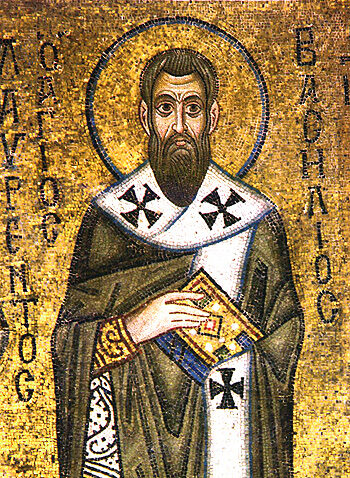
Basil of Caesarea
Basil of Caesarea was the 4th-century Christian bishop, theologian, and saint. Born 329, in Kayseri. Died January 1, 379, in Kayseri. Known for Hexaemeron and On the Holy Spirit.
Facts
25 facts · 0 confirmed by two sources · 16 cited · 9 from one source
Where this comes from
Papalocal keeps its own record. It started from these sources; what each one said is kept here as it was copied, so a change on their side never changes this page by itself. Tap one to read its version.
What Wikidata says · copied November 16, 2026 · revision 2568852980
- Described as
- 4th-century Christian bishop, theologian, and saint (329–379)
- Other names
- Basilius Magnus, St. Basil The Great, Saint Basil the Great, Basil the Great
- Born
- 329 · 5 references
- Died
- January 1, 379 · 1 reference
- Born in
- Kayseri · 2 references
- Died in
- Kayseri · 1 reference
- Citizen of
- Ancient Rome
- Occupation
- theologian · 1 reference; Catholic priest (365–) · 1 reference; philosopher · 1 reference; writer · 3 references; Catholic deacon (362–) · 1 reference; archbishop; Catholic bishop · 2 references; Church Fathers · 1 reference
- Known for
- Hexaemeron; On the Holy Spirit
- Field
- theology · 1 reference; administration and management of the church · 1 reference
- Father
- Basil the Elder
- Mother
- Emmelia of Caesarea
- Siblings
- Macrina the Younger · 1 reference; Gregory of Nyssa · 1 reference; Peter of Sebaste; Naucratius · 1 reference
- Religion
- Christianity · 1 reference; Catholic Church · 1 reference
- Wikipedias with a page
- 93
Wikidata item Q44258 (wikidata.org/wiki/Q44258), public domain (CC0). Copied November 16, 2026.
What Wikipedia says · copied November 16, 2026 · revision 1383126366
Basil of Caesarea, also called Saint Basil the Great (330 – 1 or 2 January 379), was an early Christian prelate. He served as Bishop of Caesarea Mazaca in Cappadocia from 370 until his death in 379. He was an influential theologian who supported the Nicene Creed and opposed heresies within the early Christian church such as Arianism and Apollinarianism.
In addition to his work as a theologian, Basil's most enduring legacy was the creation of the Basileias, which has been believed to be one of the earliest forms of a Christian hospital for the poor. Basil established guidelines for monastic life which focus on community life, liturgical prayer, and manual labor. Together with Pachomius, he is remembered as a father of communal monasticism in Eastern Christianity. He is considered a saint by the traditions of both Eastern and Western Christianity.
Basil, together with his brother Gregory of Nyssa and his friend Gregory of Nazianzus, are collectively referred to as the Cappadocian Fathers. The Eastern Orthodox Church and Eastern Catholic Churches have given him, together with Gregory of Nazianzus and John Chrysostom, the title of Great Hierarch. Along with them and Athanasius of Alexandria he is also regarded as one of the four Great Greek Church Fathers and is recognized as a Doctor of the Church in the Roman Catholic Church. He is sometimes referred to by the epithet Ouranophantor (Koine Greek: Οὐρανοφάντωρ), lit. 'revealer of heavenly mysteries'.
From the Wikipedia article “Basil of Caesarea” (en.wikipedia.org/wiki/Basil_of_Caesarea), by its contributors, under CC BY-SA 4.0 (creativecommons.org/licenses/by-sa/4.0/). Copied November 16, 2026; not changed.
Confirmed Two sources agree. Cited One source, and it names where it got it. One source One source, without a reference of its own. Sources disagree The sources disagree. We show the best-supported value and keep theirs below.
