
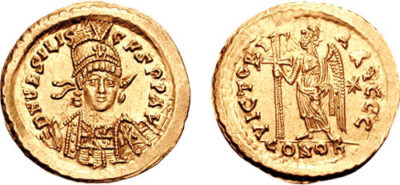
Basiliscus
Basiliscus was an Eastern Roman Emperor from 475 to 476 († 476). Born 5th century, in Cappadocia. Died 476, in Cappadocia. Positions held include ancient Roman senator, Byzantine emperor (475–476) and Roman consul.
Facts
17 facts · 0 confirmed by two sources · 1 cited · 16 from one source
Where this comes from
Papalocal keeps its own record. It started from these sources; what each one said is kept here as it was copied, so a change on their side never changes this page by itself. Tap one to read its version.
What Wikidata says · copied November 16, 2026 · revision 2548320119
- Described as
- Eastern Roman Emperor from 475 to 476 († 476)
- Other names
- Flavius Basiliscus
- Born
- 5th century
- Died
- 476
- Born in
- Cappadocia · 1 reference
- Died in
- Cappadocia
- Cause of death
- starvation
- Citizen of
- Byzantine Empire
- Occupation
- politician; military personnel · 1 reference
- Positions held
- ancient Roman senator; Byzantine emperor (475–476); Roman consul; magister militum
- Spouse
- Zenonis · 1 reference
- Children
- Marcus
- Father
- father of Basiliscus · 1 reference
- Siblings
- Verina
- Religion
- Eastern Orthodoxy · 1 reference
- Wikipedias with a page
- 55
Wikidata item Q193056 (wikidata.org/wiki/Q193056), public domain (CC0). Copied November 16, 2026.
What Wikipedia says · copied November 16, 2026 · revision 1377842047
Basiliscus (Latin: Basiliscus; Ancient Greek: Βασιλίσκος, romanized: Basilískos; died 476/477) was Eastern Roman emperor from 9 January 475 to August 476. He became magister militum per Thracias in 464, under his brother-in-law, Emperor Leo I (r. 457–474). Basiliscus commanded the army for an invasion of the Vandal Kingdom in 468, which was defeated at the Battle of Cape Bon. There were accusations at the time that Basiliscus was bribed by Aspar, the magister militum; many historians dismiss this, instead concluding that Basiliscus was either incompetent or foolish for accepting Vandal King Gaiseric's offer of a truce, which the latter used to construct fireships. Basiliscus's defeat cost the Eastern Empire 130,000 pounds (59,000 kg) of gold, causing the empire to hover above bankruptcy for 30 years. When Basiliscus returned to Constantinople, he sought refuge in the Hagia Sophia. His sister, Empress Verina, secured a pardon for him and he left the church to retire in Neapolis.
When Emperor Leo died in 474, his grandson Leo II (r. 474) took power, but soon died; his father, Zeno (r. 474–475, 476–491) ascended the throne in the same year, in a politically precarious position. Verina conspired to install the magister officiorum Patricius, her lover, as emperor. This plot was supported by Basiliscus, who succeeded in recruiting Isaurian brothers Illus and Trocundes, as well as Verina's nephew Armatus. Zeno fled on 9 January 475, either after learning of the plot or after Verina warned him that his life was in danger. Although Patricius was Verina's intended successor, Basiliscus convinced the Eastern Roman Senate to acclaim him instead.
Basiliscus quickly lost the support of his subjects and of his allies in court. Verina was alienated by the execution of Patricius, while the people objected to a combination of heavy taxes, heretical policies, and a natural disaster viewed as divine wrath for said heretical views. In an attempt to increase support, Basiliscus embraced the miaphysites, restoring Timothy Ailuros as the Patriarch of Alexandria and Peter the Fuller as Patriarch of Antioch. He heeded their advice and issued an encyclical on 9 April 475 which promoted the first three ecumenical councils of the church: Nicaea, Constantinople, and Ephesus, and condemned the Council of Chalcedon and the Tome of Leo. The Patriarch of Constantinople, Acacius, strongly opposed him, and together with Daniel the Stylite, turned the population of Constantinople against Basiliscus.
Zeno, besieged by Illus and Trocundes in his homeland of Isauria, convinced the two generals to defect, and soon the three of them marched their troops toward the capital. Basiliscus ordered Armatus to intercept them, but Armatus also switched sides after Zeno promised to give him the position of magister militum praesentalis for life, and make his son Basiliscus caesar. With Armatus's defense force deliberately kept out of his way, Zeno entered Constantinople unopposed in August 476. Basiliscus and his family hid in a church until Zeno promised not to execute them; exiled to Limnae in Cappadocia, they were either beheaded or imprisoned in a dried-up cistern and left to starve to death.
From the Wikipedia article “Basiliscus” (en.wikipedia.org/wiki/Basiliscus), by its contributors, under CC BY-SA 4.0 (creativecommons.org/licenses/by-sa/4.0/). Copied November 16, 2026; not changed.
Confirmed Two sources agree. Cited One source, and it names where it got it. One source One source, without a reference of its own. Sources disagree The sources disagree. We show the best-supported value and keep theirs below.
