
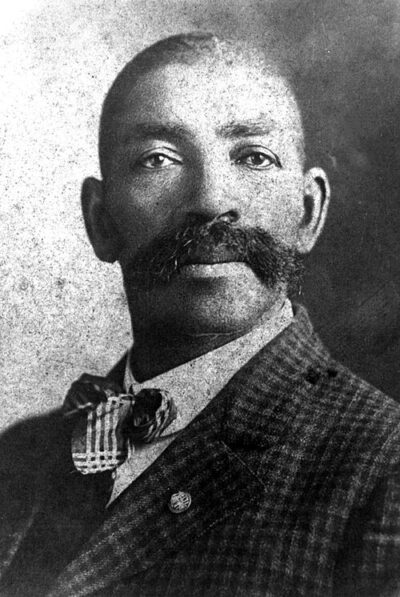
Bass Reeves was a deputy U.S. marshal. Born July 1838, in Crawford County. Died January 12, 1910, in Muskogee.
Facts
15 facts · 2 confirmed by two sources · 4 cited · 9 from one source
Where this comes from
Papalocal keeps its own record. It started from these sources; what each one said is kept here as it was copied, so a change on their side never changes this page by itself. Tap one to read its version.
What Wikidata says · copied November 18, 2026 · revision 2562998666
- Described as
- deputy U.S. marshal
- Born
- July 1838 · 1 reference
- Died
- January 12, 1910 · 2 references
- Born in
- Crawford County
- Died in
- Muskogee
- Buried in
- Harding Memorial · 1 reference
- Cause of death
- nephritis · 1 reference
- Citizen of
- United States
- Occupation
- police officer; gunfighter; farmer; scout; detective; police officer · 1 reference
- Political party
- Republican Party
- Height
- 1.88 m (6 ft 2 in) · 1 reference
- Wikipedias with a page
- 15
Wikidata item Q4867957 (wikidata.org/wiki/Q4867957), public domain (CC0). Copied November 18, 2026.
What Wikipedia says · copied November 18, 2026 · revision 1386051679
Bass Reeves (July 1838 – January 12, 1910) was a deputy U.S. Marshal, gunfighter, farmer, scout, tracker, and railroad agent who escaped from slavery. He spoke the languages of several Native American tribes including Cherokee, Choctaw, Chickasaw, Seminole, and Muscogee. Reeves was one of the first black Deputy U.S. Marshals west of the Mississippi River, mostly working in the Indian Territory. Reeves is credited with more than 3,000 arrests during his career and with killing twenty men in the line of duty.
Reeves was born into slavery in Crawford County, Arkansas. His family was enslaved by Arkansas state legislator William Steele Reeves. During the American Civil War, his enslavers fought for the Confederacy. At some point, Reeves escaped and fled to Indian Territory, where he learned American Indian languages and customs, as well as tracking and survival skills. He eventually became a farmer and rancher.
In 1875, Reeves was hired as a deputy U.S. Marshal at age 37. Reeves was well acquainted with the Indian Territory and served there for over 32 years as a peace officer, covering over 75,000 square miles in what is now Oklahoma. He accidentally shot his cook, William Leach, which led to the court case United States vs. Bass Reeves, for which he was acquitted. His first wife Jennie died in 1896.
In 1902, Reeves had to arrest his son, Benjamin "Bennie" Reeves, who was charged with murdering his wife, Castella Brown. Bennie was found guilty by a jury on January 22, 1903, in Muskogee. The presiding judge was C. W. Raymond. Bennie was sentenced to the U.S. prison at Fort Leavenworth, Kansas, for his natural life. Bennie was released after eleven years in prison and lived out the rest of his life as a model citizen.
Reeves's weapons of choice were the Winchester Models 1873 and 1892. Both rifles used cartridges (commonly .44-40) compatible with contemporary handguns, allowing him to carry a single type of ammunition. He also carried a shotgun and briefly used an 1873 Colt Single Action Army "Peacemaker" in .45 Colt. He tracked and killed outlaw Jim Webb, who had murdered over eleven people. Another outlaw Reeves encountered was murderer and horse thief Wiley Bear. Reeves rounded him up along with his gang, which included John Simmons and Sam Lasly. Reeves was involved in a gunfight with the Creek desperado Frank Buck, whom he shot and killed.
Reeves has been portrayed in popular media, including television shows, films, novels, poems, and books. He was also inducted into the Texas Trail of Fame. A bronze statue of Reeves was erected in Pendergraft Park in Fort Smith, Arkansas, and the Bass Reeves Memorial Bridge in Oklahoma was named after the lawman. A life-size statue of Reeves was erected and unveiled by the Three Rivers Museum on January 11, 2025, in Muskogee, Oklahoma.
- Born, in its opening lines
- July 1838
- Died, in its opening lines
- January 12, 1910
From the Wikipedia article “Bass Reeves” (en.wikipedia.org/wiki/Bass_Reeves), by its contributors, under CC BY-SA 4.0 (creativecommons.org/licenses/by-sa/4.0/). Copied November 18, 2026; not changed.
Confirmed Two sources agree. Cited One source, and it names where it got it. One source One source, without a reference of its own. Sources disagree The sources disagree. We show the best-supported value and keep theirs below.
