
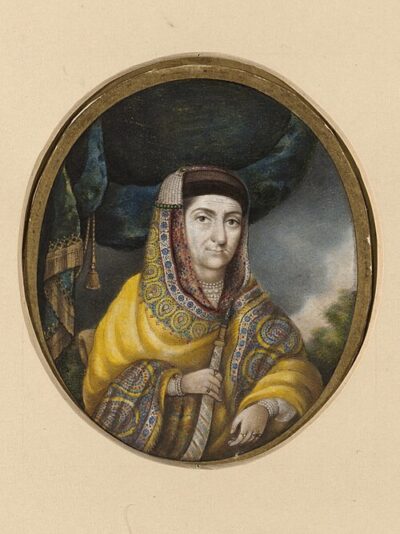
Begum Samru was a ruler of Sardhana, Meerut (c. 1753–1836). Born 1753, in Meerut. Died January 27, 1836, in Sardhana. Positions held include governance and Sardhana.
Facts
9 facts · 2 confirmed by two sources · 0 cited · 7 from one source
Where this comes from
Papalocal keeps its own record. It started from these sources; what each one said is kept here as it was copied, so a change on their side never changes this page by itself. Tap one to read its version.
What Wikidata says · copied November 18, 2026 · revision 2560333872
- Described as
- ruler of Sardhana, Meerut (c. 1753–1836)
- Other names
- Begum Sumru, Farzana Zeb un-Nissa, Joanna Nobilis Sombre
- Born
- 1753
- Died
- January 27, 1836 · 1 reference
- Born in
- Meerut
- Died in
- Sardhana
- Occupation
- politician
- Positions held
- governance; Sardhana
- Religion
- Islam; Catholicism
- Wikipedias with a page
- 23
Wikidata item Q2893871 (wikidata.org/wiki/Q2893871), public domain (CC0). Copied November 18, 2026.
What Wikipedia says · copied November 18, 2026 · revision 1376812337
Joanna Nobilis Sombre (c. 1753 – 27 January 1836), popularly known as Begum Samru (née Farzana Zeb un-Nissa), a convert Catholic Christian, started her career as a nautch (dancing) girl in 18th-century India, and eventually became the ruler of Sardhana, a small principality (jagir) near Meerut. She was the head of a professionally trained mercenary army, inherited from her European mercenary husband, Walter Reinhardt Sombre. This mercenary army consisted of Europeans and Indians. She is also regarded as the only Catholic ruler in Northern India, as she ruled the principality of Sardhana in 18th- and 19th-century India.
Begum Sumru died immensely rich but without an heir. Her inheritance was assessed at approximately 55.5 million gold marks in 1923 and 18 billion deutsch marks in 1953. Her inheritance continues to be disputed to this day. An organisation named "Reinhards Erbengemeinschaft" still strives to resolve the inheritance issue.
- Born, in its opening lines
- c. 1753
- Died, in its opening lines
- January 27, 1836
From the Wikipedia article “Begum Samru” (en.wikipedia.org/wiki/Begum_Samru), by its contributors, under CC BY-SA 4.0 (creativecommons.org/licenses/by-sa/4.0/). Copied November 18, 2026; not changed.
Confirmed Two sources agree. Cited One source, and it names where it got it. One source One source, without a reference of its own. Sources disagree The sources disagree. We show the best-supported value and keep theirs below.
