
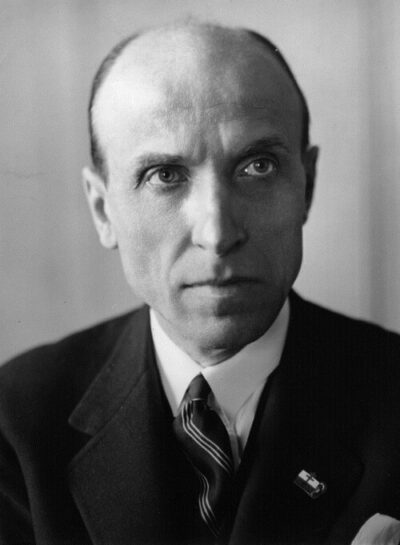
Béla Imrédy
Béla Imrédy was a Hungarian Prime Minister. Born December 29, 1891, in Budapest. Died February 28, 1946, in Budapest. Positions held include Minister of Finance in Hungary (1932–1935), Minister of Foreign Affairs of Hungary (1938) and Prime Minister of Hungary (1938–1939).
Facts
18 facts · 2 confirmed by two sources · 5 cited · 11 from one source
Where this comes from
Papalocal keeps its own record. It started from these sources; what each one said is kept here as it was copied, so a change on their side never changes this page by itself. Tap one to read its version.
What Wikidata says · copied November 17, 2026 · revision 2562811892
- Described as
- Hungarian Prime Minister (1891-1946)
- Other names
- Bela Imredy
- Born
- December 29, 1891 · 5 references
- Died
- February 28, 1946 · 6 references
- Born in
- Budapest · 1 reference
- Died in
- Budapest · 2 references
- Buried in
- Fiume Road Graveyard · 1 reference
- Cause of death
- gunshot wound
- Citizen of
- Hungary
- Occupation
- economist; politician; diplomat; banker; non-fiction writer
- Positions held
- Minister of Finance in Hungary (1932–1935) · 1 reference; Minister of Foreign Affairs of Hungary (1938); Prime Minister of Hungary (1938–1939) · 1 reference; Minister of Trade and Transport (1938); member of the National Assembly of Hungary (1939–1944) · 1 reference
- Political party
- Party of Hungarian Life · 1 reference
- Wikipedias with a page
- 25
Wikidata item Q727006 (wikidata.org/wiki/Q727006), public domain (CC0). Copied November 17, 2026.
What Wikipedia says · copied November 17, 2026 · revision 1384198493
Béla vitéz Imrédy de Ómoravicza (Hungarian: Vitéz ómoraviczai Imrédy Béla; 29 December 1891 – 28 February 1946) was Prime Minister of Hungary from 1938 to 1939.
Born in Budapest to a Catholic family, Imrédy studied law as a young man before he started working for the Hungarian Ministry of Finance. Eventually becoming a skilled economist and financier, Imrédy was made Director of the Hungarian National Bank in 1928. In 1932, he was appointed Minister of Finance under the fascist Prime Minister Gyula Gömbös. Following his resignation in 1935, Imrédy took on the role of President of the Hungarian National Bank. A highly ambitious individual, Imrédy was recognized for his right-wing perspectives on domestic and social issues. However, in matters of foreign policy, he held a pro-British stance, which ultimately contributed to his appointment as Minister of Economic Coordination under the leadership of Prime Minister Kálmán Darányi. When Darányi stepped down in May 1938, Regent Miklós Horthy appointed Imrédy as the new prime minister, marking a significant shift in Hungary's political landscape. Imrédy's diplomatic efforts to strengthen Hungary's ties with Britain were viewed unfavorably by Germany and Italy. However, he realized that alienating the two fascist powers on a long-term basis was not a good strategy, and from the autumn of 1938 onward, he pivoted Hungary's foreign policy towards pro-German and pro-Italian policies. Imrédy sought to establish himself as a prominent figure in Hungary's right-wing political scene by founding the Movement of Hungarian Life. In his pursuit of power, he didn't hesitate to eliminate rivals, and notable fascists like Ferenc Szálasi faced harassment from his administration. As Imrédy's ideology shifted further to the right, he advocated for a totalitarian overhaul of the government and introduced laws that curtailed press freedom and had devastating economic consequences for many Jewish people.In February 1939, Imrédy's moderate opponents, dissatisfied with his increasing alignment with Germany and Hungary's right-wing, presented Regent Horthy with evidence suggesting that Imrédy had Jewish ancestry through his great-grandfather. When confronted with the evidence, Imrédy was unable to refute the claims and subsequently resigned as prime minister on February 13, 1939. Imrédy went on to serve in the Hungarian Army in 1940 and later founded the Party of Hungarian Renewal, a pro-fascist and antisemitic organization, in October of that year. Following Germany's occupation of Hungary in 1944, Imrédy was considered by German Plenipotentiary Edmund Veesenmayer as the top candidate to succeed Miklós Kállay as prime minister. However, Regent Horthy refused to support the idea, and Döme Sztójay was appointed prime minister instead. Imrédy became Sztójay's Minister of Economic Coordination in May 1944, but he was forced to resign in August. After German forces were driven out of Hungary, Imrédy was arrested and tried by a People's Tribunal in November 1945. Found guilty of war crimes and collaboration with the Nazis, he was sentenced to death and executed by a firing squad in the courtyard of the jail in Markó street, Budapest, in 1946.
- Born, in its opening lines
- December 29, 1891
- Died, in its opening lines
- February 28, 1946
From the Wikipedia article “Béla Imrédy” (en.wikipedia.org/wiki/Béla_Imrédy), by its contributors, under CC BY-SA 4.0 (creativecommons.org/licenses/by-sa/4.0/). Copied November 17, 2026; not changed.
Confirmed Two sources agree. Cited One source, and it names where it got it. One source One source, without a reference of its own. Sources disagree The sources disagree. We show the best-supported value and keep theirs below.
