
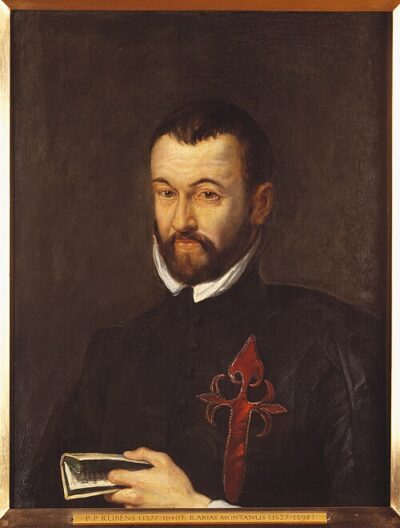
Benito Arias Montano
Benito Arias Montano was a Spanish orientalist, editor and polymath. Born 1527, in Fregenal de la Sierra. Died July 6, 1598, in Seville. Educated at University of Alcalá. Awards include Knight of the Order of Santiago.
Facts
15 facts · 2 confirmed by two sources · 7 cited · 6 from one source
Where this comes from
Papalocal keeps its own record. It started from these sources; what each one said is kept here as it was copied, so a change on their side never changes this page by itself. Tap one to read its version.
What Wikidata says · copied November 18, 2026 · revision 2567380076
- Described as
- Spanish orientalist, editor and polymath (1527–1598)
- Born
- 1527 · 17 references
- Died
- July 6, 1598 · 3 references
- Born in
- Fregenal de la Sierra · 1 reference
- Died in
- Seville · 1 reference
- Citizen of
- Spain · 1 reference
- Occupation
- linguist; librarian · 1 reference; translator; Catholic priest; biblical scholar; theologian · 1 reference; humanist · 1 reference; orientalist · 1 reference
- Education
- University of Alcalá
- Awards
- Knight of the Order of Santiago (1560–) · 1 reference
- Wikipedias with a page
- 21
Wikidata item Q816903 (wikidata.org/wiki/Q816903), public domain (CC0). Copied November 18, 2026.
What Wikipedia says · copied November 18, 2026 · revision 1385564221
Benito Arias Montano (or Benedictus Arias Montanus; 1527–1598) was a Spanish orientalist and polymath who was active mostly in Spain. He was also editor of the Antwerp Polyglot. He reached the high rank of Royal Chaplain to King Philip II of Spain. His work was censured by the Spanish Inquisition when rabbinical references were included into his Antwerp Polyglot Bible.
- Born, in its opening lines
- 1527
- Died, in its opening lines
- 1598
From the Wikipedia article “Benito Arias Montano” (en.wikipedia.org/wiki/Benito_Arias_Montano), by its contributors, under CC BY-SA 4.0 (creativecommons.org/licenses/by-sa/4.0/). Copied November 18, 2026; not changed.
Confirmed Two sources agree. Cited One source, and it names where it got it. One source One source, without a reference of its own. Sources disagree The sources disagree. We show the best-supported value and keep theirs below.
