
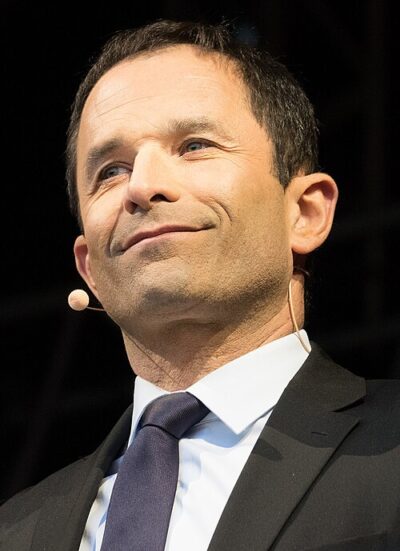
Benoît Hamon
Benoît Hamon is a French politician. Born June 26, 1967, in Saint-Renan. Positions held include Member of the European Parliament (2004–2009), member of the regional council of Île-de-France (2015–) and Minister of National Education, Higher Education and Research (2014). Educated at Université de Bretagne Occidentale.
Facts
11 facts · 1 confirmed by two sources · 6 cited · 4 from one source
Where this comes from
Papalocal keeps its own record. It started from these sources; what each one said is kept here as it was copied, so a change on their side never changes this page by itself. Tap one to read its version.
What Wikidata says · copied November 16, 2026 · revision 2562701177
- Described as
- French politician
- Born
- June 26, 1967 · 5 references
- Born in
- Saint-Renan
- Citizen of
- France
- Occupation
- politician · 2 references
- Positions held
- Member of the European Parliament (2004–2009); member of the regional council of Île-de-France (2015–) · 1 reference; Minister of National Education, Higher Education and Research (2014)
- Political party
- Socialist Party (1986–2017) · 1 reference; Génération.s (2018–) · 1 reference
- Worked for
- Singa (2021–) · 1 reference
- Education
- Université de Bretagne Occidentale · 1 reference
- Wikipedias with a page
- 48
Wikidata item Q818118 (wikidata.org/wiki/Q818118), public domain (CC0). Copied November 16, 2026.
What Wikipedia says · copied November 16, 2026 · revision 1378240604
Benoît Hamon (French: [bənwa amɔ̃]; born 26 June 1967) is a French politician known for his former role within the Socialist Party (PS) and Party of European Socialists (PES) and his political party Génération.s.
Hamon joined the Socialist Party in 1988 and by 1993 became the leader of the Young Socialist Movement, serving until 1995. In 2004, Hamon was elected MEP for East of France and during his time as MEP he ran for leadership of the Socialist Party, losing in the first round of the Reims Congress and endorsing the Eurosceptic option in the 2005 European Constitution referendum.
In 2012, Hamon was elected to the National Assembly in Yveline's 11th constituency, though he resigned after being appointed as junior minister for the Social Economy at the Ministry of the Economy, Finance, and External Trade by President François Hollande. Hamon was then appointed Minister of National Education in Manuel Valls' new government. He was removed from this position alongside Economy Minister Arnaud Montebourg when they both publicly opposed the government economic policy. He later returned to the National Assembly in September of the same year, running in his previous constituency. Hamon's stint in the National Assembly consisted of voting in line with a group labelled the Frondeurs, a socialist group opposed to the social-liberal politics of Francois Hollande and Manuel Valls.
In 2016, Hamon declared his intention to run in the Socialist Party primary for the 2017 presidential election. Being dubbed the "Jeremy Corbyn of the French-left" and "reinventing the French left", Hamon ran on ideas accused of being "far-out" such as legalising cannabis, taxing automation and introducing a universal basic income. Hamon eventually won in a run-off against former Prime Minister Manuel Valls and campaigned on similar ideals in the general election, though only gathering 6.36 per cent of votes. Shortly following his loss in the legislative election, Hamon left the Socialist Party in July 2017 to found his own political party called 1 July Movement, later renamed Génération.s.
After failing to win any seats in the 2019 European elections, Hamon said that he would step back to reflect on his and his movement's political future.
- Born, in its opening lines
- June 26, 1967
From the Wikipedia article “Benoît Hamon” (en.wikipedia.org/wiki/Benoît_Hamon), by its contributors, under CC BY-SA 4.0 (creativecommons.org/licenses/by-sa/4.0/). Copied November 16, 2026; not changed.
Confirmed Two sources agree. Cited One source, and it names where it got it. One source One source, without a reference of its own. Sources disagree The sources disagree. We show the best-supported value and keep theirs below.
