
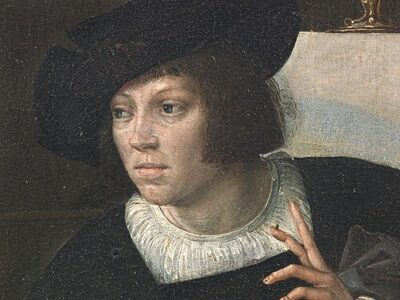
Bernard van Orley
Bernard van Orley was a Flemish draughtsman, painter (c.1488-1541). Born 1488, in Brussels. Died January 6, 1541, in Brussels. Positions held include court painter (1518–). Known for The Virgin and Child, The Last Judgement and the burial of the dead and Portrait of an unknown man and his wife.
Facts
19 facts · 0 confirmed by two sources · 10 cited · 8 from one source · 1 where the sources disagree
What’s different
- Died: we show January 6, 1541 (Sources disagree). Wikidata also lists January 6, 1542
Where this comes from
Papalocal keeps its own record. It started from these sources; what each one said is kept here as it was copied, so a change on their side never changes this page by itself. Tap one to read its version.
What Wikidata says · copied November 17, 2026 · revision 2568060638
- Described as
- Flemish draughtsman, painter (c.1488-1541)
- Other names
- Bernard Van Orlay, Barend van Orley, Barend Van Brüssel, Bernart van Orley, Bernard Van Orley, Bernaert van Orli, Barent van Orley, Bernaert Van Orley, Barend, Bernaert van Orley, Barnard of Brussels, Barend van Brüssel
- Born
- 1488 · 2 references
- Died
- January 6, 1541 · 1 reference; January 6, 1542 · 1 reference
- Born in
- Brussels · 2 references; Brussels · 1 reference
- Died in
- Brussels · 1 reference
- Citizen of
- Southern Netherlands
- Occupation
- painter · 4 references; visual artist · 1 reference; draftsperson · 1 reference; etcher · 1 reference; graphic artist · 1 reference
- Positions held
- court painter (1518–)
- Member of
- Antwerp Guild of Saint Luke; van Orley family · 1 reference
- Genre
- portrait
- Known for
- The Virgin and Child; The Last Judgement and the burial of the dead; Portrait of an unknown man and his wife; The Martyrdom of Saint John the Baptist
- Field
- visual arts · 1 reference
- Wikipedias with a page
- 25
Wikidata item Q454678 (wikidata.org/wiki/Q454678), public domain (CC0). Copied November 17, 2026.
What Wikipedia says · copied November 17, 2026 · revision 1353238978
Bernard van Orley (between 1487 and 1491 – 6 January 1541), also called Barend or Barent van Orley, Bernaert van Orley or Barend van Brussel, was a versatile Flemish artist and representative of Dutch and Flemish Renaissance painting, who was equally active as a designer of tapestries and, at the end of his life, stained glass. Although he never visited Italy, he belongs to the group of Italianizing Flemish painters called the Romanists, who were influenced by Italian Renaissance painting, in his case especially by Raphael.
He was born and died in Brussels and "served as a sort of commissioner of the arts for the Brussels town council". He was the court artist of the Habsburg rulers. He was productive, concentrating on the design of his works, and leaving their execution largely to others, in the case of painting, and entirely so, in the case of the tapestries and stained glass. This he may have learned from Raphael, whose workshop in Rome was unprecedentedly large.
Due to his reliance on workshop execution, his many surviving works vary considerably in quality. Many drawings, mostly studies for designs for tapestries and stained glass, also survive. He or his workshop would have produced full-scale cartoons for the tapestries, but these were normally lost in the course of weaving, when they were cut into strips. The prevalent subject matter of his paintings are religious scenes and portraits, and he painted only a limited number of mythological and allegorical subjects. His portraits mostly depict members of the Habsburg dynasty and were produced in multiple versions by his workshop. The subject matter of his tapestries was more varied, reflecting the normal range of that medium, from biblical cycles to allegories, battle and hunting scenes.
His father had been a tapestry designer in Brussels, and several of Bernard's descendants were artists. A number of them were still active in the 18th century.
From the Wikipedia article “Bernard van Orley” (en.wikipedia.org/wiki/Bernard_van_Orley), by its contributors, under CC BY-SA 4.0 (creativecommons.org/licenses/by-sa/4.0/). Copied November 17, 2026; not changed.
Confirmed Two sources agree. Cited One source, and it names where it got it. One source One source, without a reference of its own. Sources disagree The sources disagree. We show the best-supported value and keep theirs below.
