
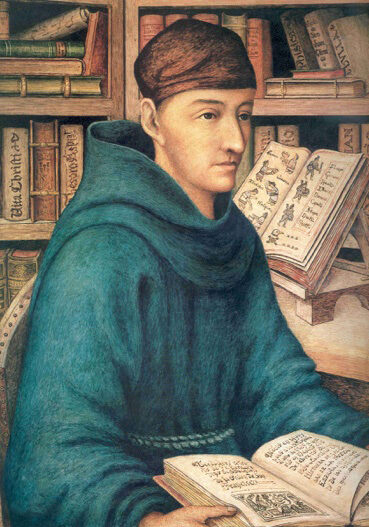
Bernardino de Sahagún
Bernardino de Sahagún was a ca. 1499-1590, Spanish mesoamericanist, evangelizador, fraile franciscano, misionero. Born 1499, in Sahagún. Died February 5, 1590, in Tlatelolco. Known for Florentine Codex. Educated at University of Salamanca.
Facts
20 facts · 2 confirmed by two sources · 6 cited · 11 from one source · 1 where the sources disagree
What’s different
- Born: we show 1499 (Confirmed). Wikidata also lists 1500
- Died: we show February 5, 1590 (Confirmed). Wikidata also lists October 23, 1590
- Died in: we show Tlatelolco (Sources disagree). Wikidata also lists New Spain
Where this comes from
Papalocal keeps its own record. It started from these sources; what each one said is kept here as it was copied, so a change on their side never changes this page by itself. Tap one to read its version.
What Wikidata says · copied November 16, 2026 · revision 2557810509
- Described as
- ca. 1499-1590, Spanish mesoamericanist, evangelizador, fraile franciscano, misionero
- Other names
- Bernardino de Sahagun
- Born
- 1499 · 11 references; 1500
- Died
- February 5, 1590; October 23, 1590
- Born in
- Sahagún · 1 reference
- Died in
- New Spain; Tlatelolco · 1 reference
- Citizen of
- Spain
- Occupation
- anthropologist; writer; missionary · 1 reference; grammarian; theologian; humanist; philosopher; mesoamericanist
- Education
- University of Salamanca
- Known for
- Florentine Codex
- Field
- Latin · 1 reference; ethnography · 1 reference; Aztec · 1 reference; Nahua · 1 reference
- Religion
- Catholic Church
- Wikipedias with a page
- 34
Wikidata item Q379972 (wikidata.org/wiki/Q379972), public domain (CC0). Copied November 16, 2026.
What Wikipedia says · copied November 16, 2026 · revision 1380077877
Bernardino de Sahagún (c. 1499 – 5 February 1590) was a Franciscan friar, missionary priest and pioneering ethnographer who participated in the Catholic evangelization of colonial New Spain (now Mexico). Born in Sahagún, Spain, in 1499, he journeyed to New Spain in 1529. He learned Nahuatl and spent more than 50 years in the study of Aztec beliefs, culture and history. Though he was primarily devoted to his missionary task, his extraordinary work documenting indigenous worldview and culture has earned him the title as "The First Anthropologist." He also contributed to the description of Nahuatl, the imperial language of the Aztec Empire. He translated the Psalms, the Gospels, and a catechism into Nahuatl.
Sahagún is perhaps best known as the compiler of the Historia general de las cosas de la Nueva España—in English, General History of the Things of New Spain—(hereinafter referred to as Historia general). The most famous extant manuscript of the Historia general is the Florentine Codex. It is a codex consisting of 2,400 pages organized into twelve books, with approximately 2,500 illustrations drawn by native artists using both native and European techniques. The alphabetic text is bilingual in Spanish and Nahuatl on opposing folios, and the pictorials should be considered a third kind of text. It documents the culture, religious cosmology (worldview), ritual practices, society, economics, and history of the Aztec people, and in Book 12 gives an account of the conquest of the Aztec Empire from the Tenochtitlan-Tlatelolco point of view. In the process of putting together the Historia general, Sahagún pioneered new methods for gathering ethnographic information and validating its accuracy. The Historia general has been called "one of the most remarkable accounts of a non-Western culture ever composed," and Sahagún has been called the father of American ethnography. In 2015, his work was declared a World Heritage by the UNESCO.
- Born, in its opening lines
- c. 1499
- Died, in its opening lines
- February 5, 1590
From the Wikipedia article “Bernardino de Sahagún” (en.wikipedia.org/wiki/Bernardino_de_Sahagún), by its contributors, under CC BY-SA 4.0 (creativecommons.org/licenses/by-sa/4.0/). Copied November 16, 2026; not changed.
Confirmed Two sources agree. Cited One source, and it names where it got it. One source One source, without a reference of its own. Sources disagree The sources disagree. We show the best-supported value and keep theirs below.
