
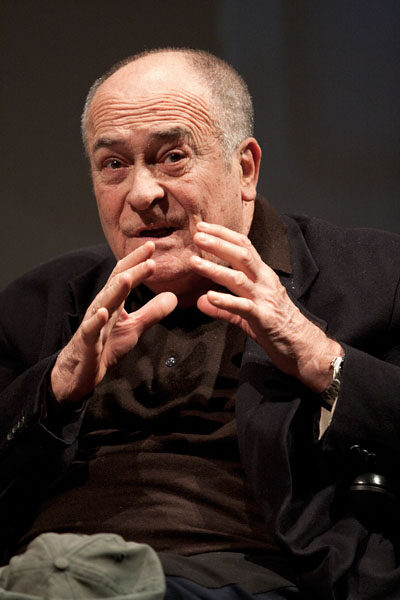
Bernardo Bertolucci
Bernardo Bertolucci was an Italian film director and screenwriter. Born March 16, 1941, in Parma. Died November 22, 2018, in Rome. Positions held include President of the Jury at the Cannes Festival (1990). Educated at Sapienza University of Rome. Awards include Academy Award for Best Director, Academy Award for Best Writing, Adapted Screenplay and Sutherland Trophy.
Facts
44 facts · 1 confirmed by two sources · 19 cited · 23 from one source · 1 where the sources disagree
What’s different
- Died: we show November 22, 2018 (Sources disagree). Wikipedia says November 26, 2018
Where this comes from
Papalocal keeps its own record. It started from these sources; what each one said is kept here as it was copied, so a change on their side never changes this page by itself. Tap one to read its version.
What Wikidata says · copied November 16, 2026 · revision 2567720609
- Described as
- Italian film director and screenwriter (1941–2018)
- Born
- March 16, 1941 · 9 references
- Died
- November 22, 2018 · 2 references
- Born in
- Parma · 3 references
- Died in
- Rome · 1 reference
- Buried in
- cemetery of Casarola
- Cause of death
- lung cancer
- Citizen of
- Kingdom of Italy (–1946); Italy (1946–) · 1 reference
- Occupation
- film director · 6 references; screenwriter · 4 references; film producer · 3 references; film actor · 2 references; film editor; poet; playwright · 1 reference; film screenwriter · 1 reference
- Positions held
- President of the Jury at the Cannes Festival (1990)
- Education
- Sapienza University of Rome
- Awards
- Academy Award for Best Director (1988) · 1 reference; Academy Award for Best Writing, Adapted Screenplay (1988) · 1 reference; Sutherland Trophy (1970); National Society of Film Critics Award for Best Director (1971); Golden Globe Award for Best Screenplay (1987); Golden Globe Award for Best Director (1987); Directors Guild of America Award for Outstanding Directing – Feature Film (1987); David di Donatello for Best Director (1988); David di Donatello for Best Film (1988); César Award for Best Foreign Film (1988); BAFTA Award for Best Film (1989); Leopard of Honour (1997) · 1 reference; Gold Medal of Merit in the Fine Arts (2001) · 1 reference; Grand Officer of the Order of Merit of the Italian Republic (1988); European Film Academy Special Jury Award (1988) · 1 reference
- Field
- film · 1 reference; film direction · 1 reference; film screenwriting · 1 reference; film production · 1 reference
- Spouse
- Adriana Asti; Maria Paola Maino (1967–1972); Clare Peploe (1979–2018) · 1 reference
- Father
- Attilio Bertolucci
- Siblings
- Giuseppe Bertolucci · 1 reference
- Religion
- atheism
- Lived in
- Parma
- Wikipedias with a page
- 87
Wikidata item Q53009 (wikidata.org/wiki/Q53009), public domain (CC0). Copied November 16, 2026.
What Wikipedia says · copied November 16, 2026 · revision 1373543594
Bernardo Bertolucci ( BUR-tə-LOO-chee; Italian: [berˈnardo bertoˈluttʃi]; 16 March 1941 – 26 November 2018) was an Italian film director and screenwriter with a career that spanned 50 years. Considered one of the greatest directors in the history of cinema, Bertolucci's work achieved international acclaim. With The Last Emperor (1987) he became the first Italian filmmaker to win the Academy Award for Best Director, and he received many other accolades including a BAFTA Award, a César Award, two Golden Globes, a Golden Lion for Lifetime Achievement, and an Honorary Palme d'Or.
A protégé of Pier Paolo Pasolini, Bertolucci made his directorial debut at 22. His second film, Before the Revolution (1964), earned strong international reviews and has since gained classic status, being called a "masterpiece of Italian cinema" by Film4. His 1970 film The Conformist, an adaptation of the Alberto Moravia novel, is considered a classic of international cinema, and was nominated for an Academy Award for Best Adapted Screenplay and the prestigious Berlin Golden Bear. His 1972 erotic drama Last Tango in Paris was controversial due to its rape scene and, later, comments made by actress Maria Schneider about her treatment on set. Bertolucci's later films such as the historical epic 1900 (1976), the family drama La Luna (1979), and the darkly comedic Tragedy of a Ridiculous Man (1981), were also controversial but acclaimed.
His 1987 film The Last Emperor, a biopic of Chinese monarch Puyi, was a critical and commercial success, earning rave reviews and sweeping the 60th Academy Awards (including Best Picture and Best Director). This was the start of what has since been described as his "Oriental Trilogy", a trio of films including The Sheltering Sky, an adaptation of the novel of the same name, and Little Buddha, a Buddhist religious epic, all three of which feature scores by Ryuichi Sakamoto. His 1996 film, Stealing Beauty, brought him his second of two Palme d'Or nominations. He continued directing well into the 21st century, releasing his final film, Me and You, in 2012.
Bertolucci's films often deal with themes of politics, sexuality, history, class conflict and social taboos, and his style has influenced several filmmakers. Several of his films have appeared on lists of the greatest films of all time. Critics have remarked that what makes Bertolucci different than other directors is his masterful combination of "visual richness and visual freedom".
- Born, in its opening lines
- March 16, 1941
- Died, in its opening lines
- November 26, 2018
From the Wikipedia article “Bernardo Bertolucci” (en.wikipedia.org/wiki/Bernardo_Bertolucci), by its contributors, under CC BY-SA 4.0 (creativecommons.org/licenses/by-sa/4.0/). Copied November 16, 2026; not changed.
Confirmed Two sources agree. Cited One source, and it names where it got it. One source One source, without a reference of its own. Sources disagree The sources disagree. We show the best-supported value and keep theirs below.
