
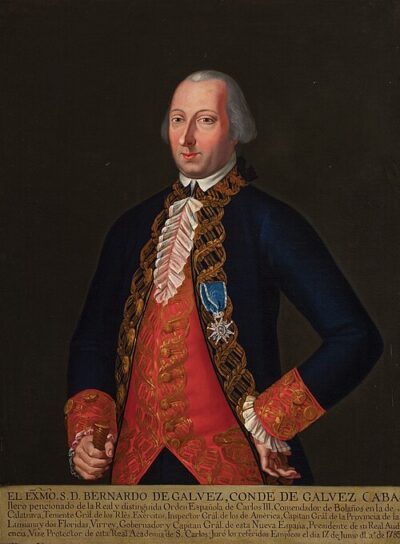
Bernardo de Gálvez
Bernardo de Gálvez was a Spanish colonial administrator. Born July 23, 1746, in Macharaviaya. Died November 30, 1786, in Tacubaya. Positions held include Viceroy of New Spain (1785–1786), governor of Spanish Louisiana (1777–1785) and Governor of Cuba (1785). Awards include honorary citizen of the United States and Order of Charles III.
Facts
21 facts · 2 confirmed by two sources · 2 cited · 17 from one source
Where this comes from
Papalocal keeps its own record. It started from these sources; what each one said is kept here as it was copied, so a change on their side never changes this page by itself. Tap one to read its version.
What Wikidata says · copied November 16, 2026 · revision 2552771392
- Described as
- Spanish colonial administrator (1746-1786)
- Other names
- Bernardo Vicente de Gálvez y Madrid
- Born
- July 23, 1746 · 3 references
- Died
- November 30, 1786 · 3 references
- Born in
- Macharaviaya
- Died in
- Tacubaya
- Name at birth
- Bernardo Vicente Apolinar de Gálvez y Madrid
- Citizen of
- Spain; United States (2014–)
- Occupation
- politician · 1 reference; military personnel; university teacher
- Positions held
- Viceroy of New Spain (1785–1786); governor of Spanish Louisiana (1777–1785); Governor of Cuba (1785); Governor of the Bahamas (1782–1783)
- Member of
- Royal Economic Society of Friends of the Country of Tenerife
- Awards
- honorary citizen of the United States (2014); Order of Charles III
- Father
- Matías de Gálvez y Gallardo
- Military branch
- Spanish Army · 1 reference
- Military rank
- Capitán General; general · 1 reference
- Wikipedias with a page
- 22
Wikidata item Q386687 (wikidata.org/wiki/Q386687), public domain (CC0). Copied November 16, 2026.
What Wikipedia says · copied November 16, 2026 · revision 1380754645
Bernardo Vicente de Gálvez y Madrid, 1st Count of Gálvez (23 July 1746 – 30 November 1786) was a Spanish military leader and government official who served as colonial governor of Spanish Louisiana and Cuba, and later as Viceroy of New Spain.
A career soldier since the age of 16, Gálvez was a veteran of several wars across Europe, the Americas, and North Africa. While governor of Louisiana, under the orders of the Spanish Crown he supported the colonists and their French allies in the American Revolutionary War, helping facilitate vital supply lines and frustrate British operations in the Gulf Coast. Under Gálvez's command, Spanish troops achieved several victories on the battlefield, most notably conquering West Florida and eliminating the British naval presence in the Gulf. This campaign led to the formal return of all of Florida to Spain in the Treaty of Paris, which he played a role in drafting.
Gálvez's actions aided the American war effort and made him a hero to both Spain and the newly independent United States. The U.S. Congress endeavored to hang his portrait in the Capitol, finally doing so in 2014. He was granted many titles and honors by the Spanish government, which in 1783 appointed him viceroy of one of its most valuable territories, New Spain, succeeding his father Matías de Gálvez y Gallardo. He served until his death from typhus.
While somewhat forgotten in the United States, Gálvez remains in high esteem among many Americans, particularly in the southern and western states that once formed part of Spain's North American territory. Gálvez Day is celebrated as a local holiday in Pensacola, and several places bear his name, including Galveston, Texas and Galvez, Louisiana. In 2014, Gálvez became one of only eight people to have been awarded honorary U.S. citizenship.
- Born, in its opening lines
- July 23, 1746
- Died, in its opening lines
- November 30, 1786
From the Wikipedia article “Bernardo de Gálvez” (en.wikipedia.org/wiki/Bernardo_de_Gálvez), by its contributors, under CC BY-SA 4.0 (creativecommons.org/licenses/by-sa/4.0/). Copied November 16, 2026; not changed.
Confirmed Two sources agree. Cited One source, and it names where it got it. One source One source, without a reference of its own. Sources disagree The sources disagree. We show the best-supported value and keep theirs below.
