
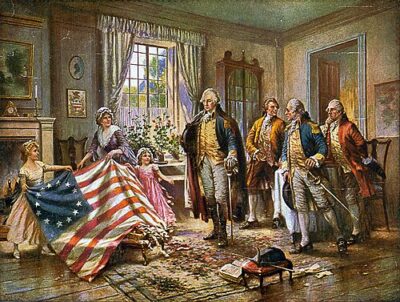
Betsy Ross
Betsy Ross was an American upholsterer who was credited by her relatives with making the first American flag. Born January 1, 1752, in Philadelphia. Died January 30, 1836, in Philadelphia. Known for Betsy Ross flag.
Facts
14 facts · 2 confirmed by two sources · 4 cited · 8 from one source
Where this comes from
Papalocal keeps its own record. It started from these sources; what each one said is kept here as it was copied, so a change on their side never changes this page by itself. Tap one to read its version.
What Wikidata says · copied November 15, 2026 · revision 2566778972
- Described as
- American upholsterer who was credited by her relatives with making the first American flag
- Other names
- Betsy Claypoole, Elizabeth Griscom Ross, Elizabeth Griscom, Betsy Ashburn, Elizabeth Phoebe Griscom “Betsy” Ross, Elizabeth Ross
- Born
- January 1, 1752 · 3 references
- Died
- January 30, 1836 · 3 references
- Born in
- Philadelphia · 1 reference
- Died in
- Philadelphia · 1 reference
- Buried in
- Mount Moriah Cemetery
- Citizen of
- Kingdom of Great Britain; United States
- Occupation
- designer · 1 reference; upholsterer; seamster · 1 reference
- Known for
- Betsy Ross flag
- Spouse
- John Ross
- Children
- Susannah Griscom Satterthwaite · 1 reference
- Lived in
- Pennsylvania
- Wikipedias with a page
- 29
Wikidata item Q234952 (wikidata.org/wiki/Q234952), public domain (CC0). Copied November 15, 2026.
What Wikipedia says · copied November 15, 2026 · revision 1373144358
Elizabeth Griscom Ross (née Griscom; January 1, 1752 – January 30, 1836), also known by her second and third married names, Ashburn and Claypoole, was an American upholsterer who was credited by her relatives in 1870 with designing and making the first U.S. flag, commonly known as the Betsy Ross flag. Though historians dismissed the story both then and now, Ross family tradition holds that General George Washington, commander-in-chief of the Continental Army and two members of a congressional committee—Robert Morris and George Ross—visited Ross in 1776. Ross convinced Washington to change the shape of the stars in a sketch of a flag he showed her from six-pointed to five-pointed by demonstrating that it was easier and speedier to cut the latter. However, there is no archival evidence or other recorded verbal tradition to substantiate this story of the first U.S. flag. It appears that the story first surfaced in the writings of her grandson in the 1870s (a century after the fact), with no mention or documentation in earlier decades. The myth was later incorporated into a large oil painting that appeared at the 1893 Chicago World's fair. The painter, Charles Weisgerber, subsequently promoted the myth, even buying a house he deemed The Betsy Ross House. He solicited money nationwide for the upkeep of the house as a tourist attraction. With the solicitations, he provided a synopsis of the myth with reproductions of his painting.
Ross made flags for the Pennsylvania Navy during the American Revolution. After the Revolution, she made U.S. flags for over 50 years, including 50 garrison flags for the U.S. Arsenal on the Schuylkill River during 1811. The flags of the Pennsylvania navy were overseen by the Pennsylvania Navy Board. The board reported to the Pennsylvania Provincial Assembly's Committee of Safety. In July 1775, the President of the Committee of Safety was Benjamin Franklin. Its members included Robert Morris and George Ross. At that time, the committee ordered the construction of gunboats that would eventually need flags as part of their equipment. As late as October 1776, Captain William Richards was still writing to the Committee of Safety to request the design that he could use to order flags for the fleet.
Ross was one of those hired to make flags for the Pennsylvanian fleet. An entry dated May 29, 1777, in the records of the Pennsylvania Navy Board, includes an order to pay her for her work. It is worded as follows:The Pennsylvania navy's ship colors included an ensign, a long, narrow pennant, and a short, narrow pennant. The ensign was a blue flag with 13 stripes—seven red stripes and six white stripes in the flag's canton (upper-left-hand corner). It was flown from a pole at the rear of the ship. The long pennant had 13 vertical, red-and-white stripes near the mast; the rest was solid red. It flew from the top of the ship's mainmast, the center pole holding the sails. The short pennant was solid red, and flew from the top of the ship's mizzenmast—the pole holding the ship's sails nearest the stern (rear of the ship).
- Born, in its opening lines
- January 1, 1752
- Died, in its opening lines
- January 30, 1836
From the Wikipedia article “Betsy Ross” (en.wikipedia.org/wiki/Betsy_Ross), by its contributors, under CC BY-SA 4.0 (creativecommons.org/licenses/by-sa/4.0/). Copied November 15, 2026; not changed.
Confirmed Two sources agree. Cited One source, and it names where it got it. One source One source, without a reference of its own. Sources disagree The sources disagree. We show the best-supported value and keep theirs below.
