
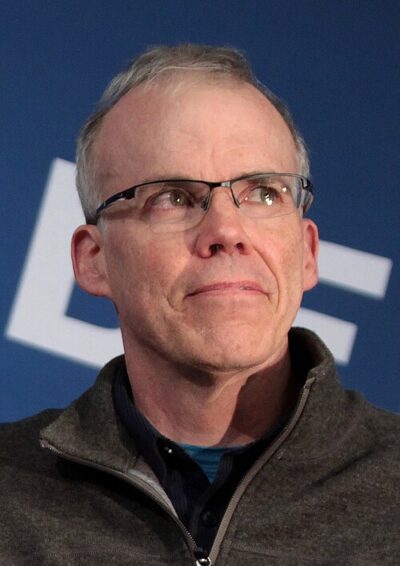
Bill McKibben
Bill McKibben is an American environmentalist and writer. Born December 8, 1960, in Palo Alto. Known for The End of Nature. Educated at Harvard University and Lexington High School. Awards include Guggenheim Fellowship, Sophie Prize and Gandhi Peace Award.
Facts
21 facts · 1 confirmed by two sources · 6 cited · 14 from one source
Where this comes from
Papalocal keeps its own record. It started from these sources; what each one said is kept here as it was copied, so a change on their side never changes this page by itself. Tap one to read its version.
What Wikidata says · copied November 16, 2026 · revision 2536407200
- Described as
- American environmentalist and writer
- Other names
- William Ernest McKibben
- Born
- December 8, 1960 · 5 references
- Born in
- Palo Alto · 2 references
- Citizen of
- United States
- Occupation
- writer; activist; environmentalist · 1 reference; climate activist; journalist · 1 reference
- Education
- Harvard University (1978–1982) · 2 references; Lexington High School (1975–1978) · 1 reference
- Member of
- American Academy of Arts and Sciences; 350.org
- Known for
- The End of Nature
- Awards
- Guggenheim Fellowship · 1 reference; Sophie Prize (2013); Gandhi Peace Award (2013); Right Livelihood Award (2014); John Muir Award (2011); Rose-Walters Prize (2012) · 1 reference
- Spouse
- Sue Halpern
- Website
- http://www.billmckibben.com/
- Wikipedias with a page
- 22
Wikidata item Q503815 (wikidata.org/wiki/Q503815), public domain (CC0). Copied November 16, 2026.
What Wikipedia says · copied November 16, 2026 · revision 1379901941
William Ernest McKibben (born December 8, 1960) is an American environmentalist, author, and journalist who has written extensively on the impact of global warming. He is the Schumann Distinguished Scholar of environmental studies at Middlebury College and leader of the climate campaign groups 350.org and the Third Act Movement. He has authored a dozen books about the environment, including his first, The End of Nature (1989), about climate change, Falter: Has the Human Game Begun to Play Itself Out? (2019), and Here Comes the Sun (2025) about the state of the environmental challenges facing humanity and future prospects.
In 2009, he led 350.org's organization of 5,200 simultaneous demonstrations in 181 countries. In 2010, McKibben and 350.org conceived the 10/10/10 Global Work Party, which convened more than 7,000 events in 188 countries, as he had told a large gathering at Warren Wilson College shortly before the event. In December 2010, 350.org coordinated a planet-scale art project, with many of the 20 works visible from satellites. In 2011 and 2012 he led the environmental campaign against the proposed Keystone XL pipeline project and spent three days in jail in Washington, D.C. Two weeks later he was inducted into the literature section of the American Academy of Arts and Sciences.
He was awarded the Gandhi Peace Award in 2013. Foreign Policy magazine named him to its inaugural list of the 100 most important global thinkers in 2009 and MSN named him one of the dozen most influential men of 2009. In 2010, The Boston Globe called him "probably the nation's leading environmentalist" and Time magazine book reviewer Bryan Walsh described him as "the world's best green journalist". In 2014, he was awarded the Right Livelihood Award for "mobilizing growing popular support in the USA and around the world for strong action to counter the threat of global climate change." In 2019, Aidan Smith, writing for Current Affairs, mentioned McKibben as a possible future Secretary of the Interior or Secretary of Energy in the cabinet of a hypothetical future progressive President.
- Born, in its opening lines
- December 8, 1960
From the Wikipedia article “Bill McKibben” (en.wikipedia.org/wiki/Bill_McKibben), by its contributors, under CC BY-SA 4.0 (creativecommons.org/licenses/by-sa/4.0/). Copied November 16, 2026; not changed.
Confirmed Two sources agree. Cited One source, and it names where it got it. One source One source, without a reference of its own. Sources disagree The sources disagree. We show the best-supported value and keep theirs below.
