
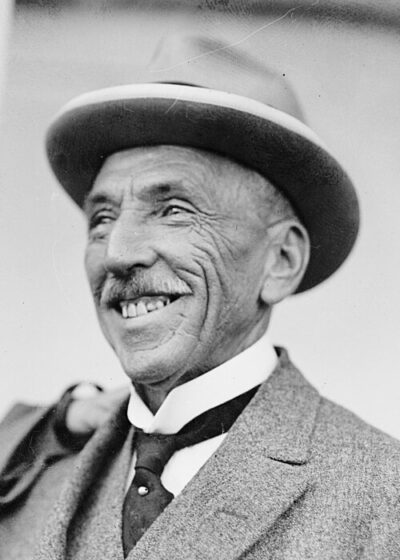
Billy Hughes
Billy Hughes was an Australian politician (1862–1952), 7th Prime Minister of Australia from 1915 to 1923. Born September 25, 1862, in London. Died October 28, 1952, in Sydney. Positions held include Prime Minister of Australia (1915–1923), Attorney-General for Australia (2 times) (1908–1941) and member of the Australian House of Representatives (1901–1952). Awards include Companion of Honour.
Facts
24 facts · 2 confirmed by two sources · 6 cited · 16 from one source
Where this comes from
Papalocal keeps its own record. It started from these sources; what each one said is kept here as it was copied, so a change on their side never changes this page by itself. Tap one to read its version.
What Wikidata says · copied November 16, 2026 · revision 2563365520
- Described as
- Australian politician (1862–1952), 7th Prime Minister of Australia from 1915 to 1923
- Other names
- William Morris Hughes, William Hughes, The Right Honourable William Hughes, W.M. Hughes, William Morris "Billy" Hughes
- Born
- September 25, 1862 · 6 references
- Died
- October 28, 1952 · 8 references
- Born in
- London · 2 references
- Died in
- Sydney · 1 reference
- Buried in
- Macquarie Park Cemetery and Crematorium · 1 reference
- Citizen of
- Australia · 1 reference
- Occupation
- politician · 1 reference; diplomat; head of government · 1 reference; social democrat · 1 reference
- Positions held
- Prime Minister of Australia (1915–1923); Attorney-General for Australia (2 times) (1908–1941); member of the Australian House of Representatives (1901–1952); Member of the New South Wales Legislative Assembly (1894–1901); Minister for Foreign Affairs (Australia); Member of the Privy Council of the United Kingdom
- Political party
- Australian Labor Party (–1916); National Labor Party (1916–1917); Nationalist Party of Australia (1917–1929); United Australia Party (1931–1944)
- Awards
- Companion of Honour · 1 reference
- Spouse
- Mary Hughes
- Children
- Helen Beatrice Hughes
- Religion
- Baptists
- Wikipedias with a page
- 50
Wikidata item Q152666 (wikidata.org/wiki/Q152666), public domain (CC0). Copied November 16, 2026.
What Wikipedia says · copied November 16, 2026 · revision 1385758557
William Morris Hughes (25 September 1862 – 28 October 1952) was the seventh prime minister of Australia, serving from 1915 to 1923. He led the nation during World War I, and his influence on national politics spanned several decades. He was a member of the federal parliament from the Federation of Australia in 1901 until his death in 1952, and is the only person to have served as a parliamentarian for more than 50 years. He represented six political parties during his career, leading five, outlasting four, and being expelled from three.
Hughes was born in London to Welsh parents. He emigrated to Australia at the age of 22, and became involved in the fledgling Australian labour movement. He was elected to the New South Wales Legislative Assembly in 1894, as a member of the New South Wales Labor Party, and then transferred to the new federal parliament in 1901. Hughes combined his early political career with part-time legal studies, and was called to the bar in 1903. He first entered cabinet in 1904, in the short-lived Watson government, and was later the attorney-general of Australia in each of Andrew Fisher's governments. He was elected deputy leader of the Australian Labor Party in 1914.
Hughes became prime minister in October 1915, when Fisher retired due to ill health. The war was the dominant issue of the time, and his support for sending conscripted troops overseas caused a split within Labor ranks. Hughes and his supporters were expelled from the party in November 1916, but he was able to remain in power at the head of the new National Labor Party, which after a few months merged with the Liberals to form the Nationalist Party. His conservative governments were re-elected with large majorities at the 1917 and 1919 elections. Hughes established the forerunners of the Australian Federal Police and the CSIRO during the war, and also created a number of new state-owned enterprises to aid the post-war economy. He made a significant impression on other world leaders at the 1919 Paris Peace Conference, where he secured Australian control of the former German New Guinea.
At the 1922 Australian federal election, the Nationalists lost their majority in parliament and were forced to form a coalition with the Country Party. Hughes's resignation was the price for Country Party support, and he was succeeded as prime minister by Stanley Bruce. He became one of Bruce's leading critics over time, and in 1928, following a dispute over industrial relations, he and his supporters crossed the floor on a confidence motion and brought down the government. After a period as an independent, Hughes formed his own organisation, the Australian Party, which in 1931 merged into the new United Australia Party (UAP). He returned to cabinet in 1934, and became known for his prescient warnings against Japanese imperialism. As late as 1939, he missed out on a second stint as prime minister by only a handful of votes, losing the 1939 United Australia Party leadership election to Robert Menzies.
Hughes is generally acknowledged as one of the most influential Australian politicians of the 20th century. He was a controversial figure throughout his lifetime, and his legacy continues to be debated by historians. His strong views and abrasive manner meant he frequently made political enemies, often from within his own parties. Hughes's opponents accused him of engaging in authoritarianism and populism, as well as inflaming sectarianism; his use of the War Precautions Act 1914 was particularly controversial. His former colleagues in the Labor Party considered him a traitor, while conservatives were suspicious of what they viewed as his socialist economic policies. He was extremely popular among the general public, particularly ex-servicemen, who affectionately nicknamed him "the little digger".
- Born, in its opening lines
- September 25, 1862
- Died, in its opening lines
- October 28, 1952
From the Wikipedia article “Billy Hughes” (en.wikipedia.org/wiki/Billy_Hughes), by its contributors, under CC BY-SA 4.0 (creativecommons.org/licenses/by-sa/4.0/). Copied November 16, 2026; not changed.
Confirmed Two sources agree. Cited One source, and it names where it got it. One source One source, without a reference of its own. Sources disagree The sources disagree. We show the best-supported value and keep theirs below.
