
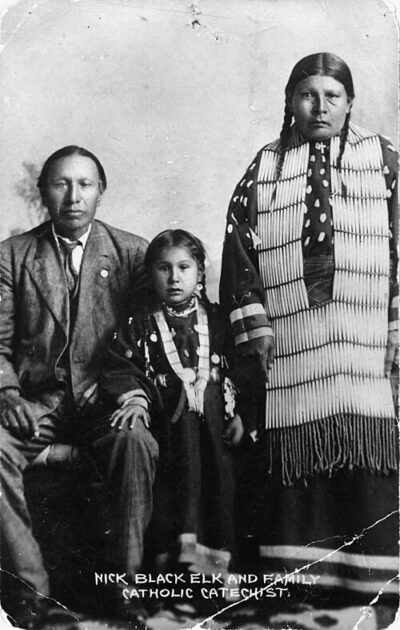
Black Elk
Black Elk was an Oglala Lakota leader. Born December 1, 1863, in Little Powder River. Died August 19, 1950, in Pine Ridge Indian Reservation.
Facts
13 facts · 2 confirmed by two sources · 3 cited · 8 from one source
Where this comes from
Papalocal keeps its own record. It started from these sources; what each one said is kept here as it was copied, so a change on their side never changes this page by itself. Tap one to read its version.
What Wikidata says · copied November 16, 2026 · revision 2565564797
- Described as
- Oglala Lakota leader (1863–1950)
- Other names
- Heȟáka Sápa
- Born
- December 1, 1863
- Died
- August 19, 1950 · 1 reference
- Born in
- Little Powder River
- Died in
- Pine Ridge Indian Reservation
- Buried in
- Manderson-White Horse Creek
- Occupation
- medicine man; Heyoka; traditional leader or chief; healer · 1 reference
- Field
- rite · 1 reference; ritual · 1 reference
- Children
- Ben Black Elk
- Religion
- Catholic Church
- Wikipedias with a page
- 31
Wikidata item Q436655 (wikidata.org/wiki/Q436655), public domain (CC0). Copied November 16, 2026.
What Wikipedia says · copied November 16, 2026 · revision 1384535207
Heȟáka Sápa, commonly known as Black Elk (baptized Nicholas; December 1, 1863 – August 19, 1950), was a wičháša wakȟáŋ ("medicine man, holy man") and heyoka of the Oglala Lakota people. He was a second cousin of the war leader Crazy Horse and fought with him in the Battle of Little Bighorn. He survived the Wounded Knee Massacre in 1890. He toured and performed in Europe as part of Buffalo Bill's Wild West.
Black Elk is best known for his interviews with poet John Neihardt, where he discussed his religious views, visions, and events from his life. Neihardt published these in his book Black Elk Speaks in 1932. This book has since been published in numerous editions, most recently in 2008. Near the end of his life, he also spoke to American ethnologist Joseph Epes Brown for his 1947 book The Sacred Pipe. There has been great interest in these works among diverse people interested in Native American religions, notably those in the pan-Indian movement.
Black Elk converted to Catholicism, becoming a catechist, but he also continued to practice Lakota ceremonies. The Diocese of Rapid City opened an official cause for his canonization in 2016.
- Born, in its opening lines
- December 1, 1863
- Died, in its opening lines
- August 19, 1950
From the Wikipedia article “Black Elk” (en.wikipedia.org/wiki/Black_Elk), by its contributors, under CC BY-SA 4.0 (creativecommons.org/licenses/by-sa/4.0/). Copied November 16, 2026; not changed.
Confirmed Two sources agree. Cited One source, and it names where it got it. One source One source, without a reference of its own. Sources disagree The sources disagree. We show the best-supported value and keep theirs below.
