
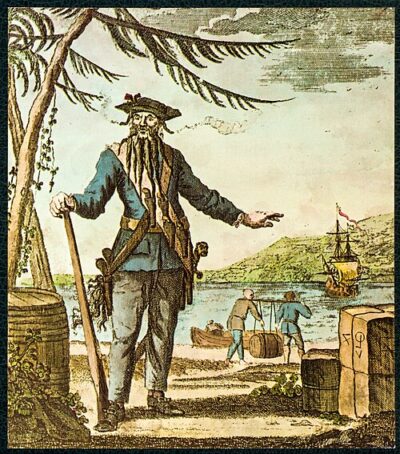
Blackbeard was an English pirate. Born 1680, in Bristol. Died November 22, 1718, in Ocracoke.
Facts
9 facts · 2 confirmed by two sources · 1 cited · 6 from one source
Where this comes from
Papalocal keeps its own record. It started from these sources; what each one said is kept here as it was copied, so a change on their side never changes this page by itself. Tap one to read its version.
What Wikidata says · copied November 16, 2026 · revision 2538674624
- Described as
- English pirate
- Other names
- Edward Thatch, Captain Blackbeard, Edward Teach, Capt. Blackbeard
- Born
- 1680 · 3 references
- Died
- November 22, 1718 · 3 references
- Born in
- Bristol
- Died in
- Ocracoke
- Cause of death
- decapitation
- Citizen of
- Kingdom of Great Britain
- Occupation
- pirate · 1 reference
- Spouse
- CIELINOS ALVAREZ
- Military rank
- captain
- Wikipedias with a page
- 67
Wikidata item Q213518 (wikidata.org/wiki/Q213518), public domain (CC0). Copied November 16, 2026.
What Wikipedia says · copied November 16, 2026 · revision 1378971369
Edward Teach (or Thatch; c. 1680 – 22 November [3 December N.S.] 1718), better known as Blackbeard, was an English pirate who operated around the West Indies and the eastern coast of Britain's North American colonies. He remains one of history's most well-known pirates.
Little is known about Blackbeard's early life, but he may have been a sailor on privateering ships during Queen Anne's War before he settled on the Bahamian island of New Providence, a base for Captain Benjamin Hornigold, whose crew Teach joined around 1716. Hornigold placed him in command of a sloop that he had captured, and the two engaged in numerous acts of piracy. Their numbers were boosted by the addition to their fleet of two more ships, one of which was commanded by Stede Bonnet, but Hornigold retired from piracy toward the end of 1717, taking two vessels with him.
Teach captured a French slave ship known as La Concorde, renamed her Queen Anne's Revenge, equipped her with 40 guns, and crewed her with over 300 men. His nickname derived from his thick black beard and menacing appearance. He was reported to have tied lit fuses (slow matches) under his hat to frighten his enemies. He formed an alliance of pirates and blockaded the port of Charles Town, South Carolina, ransoming its inhabitants. He then ran Queen Anne's Revenge aground on a sandbar near Beaufort, North Carolina. He parted company with Stede Bonnet and settled in Bath, North Carolina, historically known as Bath Town, where he accepted a royal pardon. However, he was soon back at sea, where he attracted the attention of Alexander Spotswood, the governor of Virginia. Spotswood arranged for a party of soldiers and sailors to capture him. On 22 November [3 December N.S.] 1718, following the battle at Ocracoke Inlet, Teach and several of his crew were killed by a small force of sailors led by Lieutenant Robert Maynard. His flagship Queen Anne's Revenge was discovered by divers in November 1996 in Beaufort Inlet off the coast of North Carolina.
Teach was a shrewd and calculating leader who spurned the use of violence, relying instead on his fearsome image to elicit the response that he desired from those whom he robbed. He was romanticised after his death and became the inspiration for an archetypal pirate in works of fiction across many genres.
- Born, in its opening lines
- c. 1680
- Died, in its opening lines
- November 22, 1718
From the Wikipedia article “Blackbeard” (en.wikipedia.org/wiki/Blackbeard), by its contributors, under CC BY-SA 4.0 (creativecommons.org/licenses/by-sa/4.0/). Copied November 16, 2026; not changed.
Confirmed Two sources agree. Cited One source, and it names where it got it. One source One source, without a reference of its own. Sources disagree The sources disagree. We show the best-supported value and keep theirs below.
