
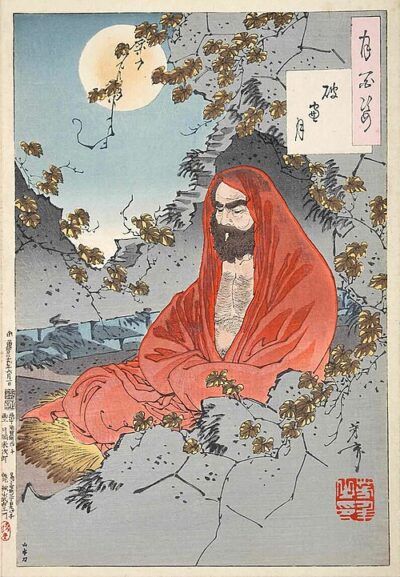
Bodhidharma
Bodhidharma was an Indian-Chinese philosopher and Buddhist Monk. Born 483, in Kanchipuram. Died 540, in Shaolin Monastery. Known for Long Scroll of the Treatise on the Two Entrances and Four Practices.
Facts
14 facts · 0 confirmed by two sources · 3 cited · 10 from one source · 1 where the sources disagree
What’s different
- Born: we show 483 (Sources disagree). Wikidata also lists 440
Where this comes from
Papalocal keeps its own record. It started from these sources; what each one said is kept here as it was copied, so a change on their side never changes this page by itself. Tap one to read its version.
What Wikidata says · copied November 16, 2026 · revision 2561598191
- Described as
- Indian-Chinese philosopher and Buddhist Monk
- Other names
- Damo, Daruma
- Born
- 483; 440
- Died
- 540
- Born in
- Kanchipuram
- Died in
- Shaolin Monastery
- Citizen of
- Northern Wei
- Occupation
- Buddhist monk; philosopher; Zen master; monk · 1 reference
- Known for
- Long Scroll of the Treatise on the Two Entrances and Four Practices
- Field
- Zen · 1 reference; kung fu · 1 reference
- Religion
- Buddhism; Zen
- Wikipedias with a page
- 66
Wikidata item Q187172 (wikidata.org/wiki/Q187172), public domain (CC0). Copied November 16, 2026.
What Wikipedia says · copied November 16, 2026 · revision 1382208115
Bodhidharma was a semi-legendary Buddhist monk who lived during the 5th or 6th century CE. He is traditionally credited as the transmitter of Chan Buddhism to China, and is regarded as its first Chinese patriarch. He is also popularly regarded as the founder of Shaolin kung fu, an idea popularized in the 20th century, but based on the 17th-century Yijin Jing and the Daoist association of daoyin gymnastics with Bodhidharma.
Little contemporary biographical information on Bodhidharma exists, and subsequent accounts are layered with legend and unreliable details. According to the principal Chinese sources, Bodhidharma came from the Western Regions, which typically refers to modern-day Xinjiang and Central Asia but can also include the Indian subcontinent. He is described as either a "Persian Central Asian" or a "South Indian [...] the third son of a great Indian king." Aside from the Chinese accounts, several popular traditions also exist regarding Bodhidharma's origins. Throughout Buddhist art, Bodhidharma is depicted as an ill-tempered, large-nosed, profusely bearded, wide-eyed non-Chinese person.
The accounts also differ on the date of his arrival. One early account claims that he arrived during the Liu Song dynasty (420–479 CE). Later accounts date his arrival to the Liang dynasty (502–557 CE). Bodhidharma was primarily active in the territory of the Northern Wei (386–534 CE). Modern scholarship dates him to about the early 5th century CE.
Bodhidharma's teachings and practice center on meditation and the Laṅkāvatāra Sūtra. The Anthology of the Patriarchal Hall (952) identifies Bodhidharma as the 28th Patriarch of Buddhism in an uninterrupted line that extends back to the Gautama Buddha himself.
From the Wikipedia article “Bodhidharma” (en.wikipedia.org/wiki/Bodhidharma), by its contributors, under CC BY-SA 4.0 (creativecommons.org/licenses/by-sa/4.0/). Copied November 16, 2026; not changed.
Confirmed Two sources agree. Cited One source, and it names where it got it. One source One source, without a reference of its own. Sources disagree The sources disagree. We show the best-supported value and keep theirs below.
