
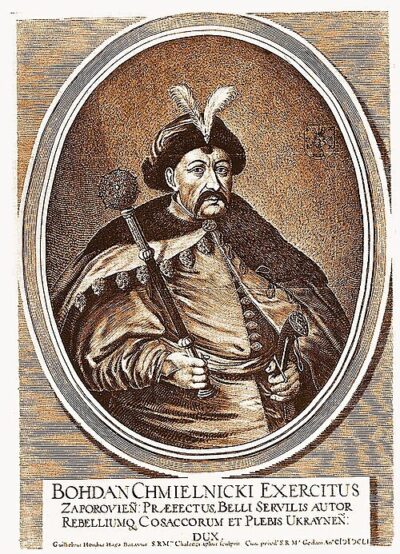
Bohdan Khmelnytsky
Bohdan Khmelnytsky was an Ukrainian military, political and statesman, Hetman of the Zaporizhzhya Army, head of Ukraine (1648–1657) during the Hetmanship. Born 1595, in Subotiv. Died July 27, 1657, in Chyhyryn. Positions held include Hetman of Zaporizhian Host (1648–1657).
Facts
22 facts · 1 confirmed by two sources · 1 cited · 19 from one source · 1 where the sources disagree
What’s different
- Died: we show July 27, 1657 (Sources disagree). Wikipedia says August 6, 1657
Where this comes from
Papalocal keeps its own record. It started from these sources; what each one said is kept here as it was copied, so a change on their side never changes this page by itself. Tap one to read its version.
What Wikidata says · copied November 16, 2026 · revision 2557821095
- Described as
- Ukrainian military, political and statesman, Hetman of the Zaporizhzhya Army, head of Ukraine (1648–1657) during the Hetmanship
- Other names
- Bohdan Khmelnytskyi
- Born
- 1595
- Died
- July 27, 1657 · 1 reference
- Born in
- Subotiv
- Died in
- Chyhyryn · 1 reference
- Buried in
- St. Elijah Church, Subotiv
- Cause of death
- stroke
- Citizen of
- Polish–Lithuanian Commonwealth (–1648); Cossack Hetmanate (1648–)
- Occupation
- politician · 1 reference; military leader; diplomat
- Positions held
- Hetman of Zaporizhian Host (1648–1657)
- Spouse
- Olena Chaplynska (1649–1651); Anna Zolotarenko (1651–) · 1 reference; Hanna Somko (1623–1647) · 1 reference
- Children
- Tymish Khmelnytsky · 1 reference; Catherine Bogdanovna Khmelnytsky · 1 reference; Olena Khmelnytska · 1 reference; Yurii Khmelnytskyi
- Father
- Michał Chmielnicki
- Religion
- Eastern Orthodox Church · 1 reference
- Military rank
- ataman
- Wikipedias with a page
- 69
Wikidata item Q203808 (wikidata.org/wiki/Q203808), public domain (CC0). Copied November 16, 2026.
What Wikipedia says · copied November 16, 2026 · revision 1382885958
Zynoviy Bohdan Mykhailovych Khmelnytsky of the Abdank coat of arms (c. 1595 – 6 August 1657) was a Ruthenian nobleman and military commander of Zaporozhian Cossacks as Hetman of the Zaporozhian Host, which was then under the suzerainty of the Polish–Lithuanian Commonwealth. He led the Cossacks to victory in a successful uprising against the Commonwealth and its magnates (1648–1654) that resulted in the creation of an independent Cossack state in Dnieper Ukraine.
In 1648–1649, the Cossacks under Khmelnytskyi's leadership massacred tens of thousands of Poles and Jews, with more handed over as yasir (slaves) to his Crimean Tatar allies, one of the most traumatic events in Polish and Jewish history. Under his rule of the newly established Cossack state, the massacres continued until at least 1652 and possibly led to hundreds of thousands of deaths, with the goal of eradicating non-Orthodox Ruthenian populations. In 1654, Khmelnytsky concluded the Treaty of Pereiaslav with the Russian Tsar and allied the Cossack Hetmanate with Tsardom of Russia, thus placing Ukraine under Russian protection.
Khmelnytsky's uprising permanently changed the balance of power in Europe and would play a significant role in the development of Ukrainian nationalism. In Western Europe, Khmelnytsky was compared to his rebel contemporary, Oliver Cromwell. Among Ukrainians, Khmelnytsky has been lauded as a folk hero and defender of the Orthodox faith, as well as a fighter for Ukrainian independence and founder of the first Ukrainian state; Russian imperial and Soviet propaganda meanwhile promoted him as a "unifier" of Ukraine with Russia. However, even among his compatriots Khmelnytskyi's image remained controversial due to his questionable alliances and harsh policies, which caused the death and enslavement of numerous people.
- Born, in its opening lines
- c. 1595
- Died, in its opening lines
- August 6, 1657
From the Wikipedia article “Bohdan Khmelnytsky” (en.wikipedia.org/wiki/Bohdan_Khmelnytsky), by its contributors, under CC BY-SA 4.0 (creativecommons.org/licenses/by-sa/4.0/). Copied November 16, 2026; not changed.
Confirmed Two sources agree. Cited One source, and it names where it got it. One source One source, without a reference of its own. Sources disagree The sources disagree. We show the best-supported value and keep theirs below.
