
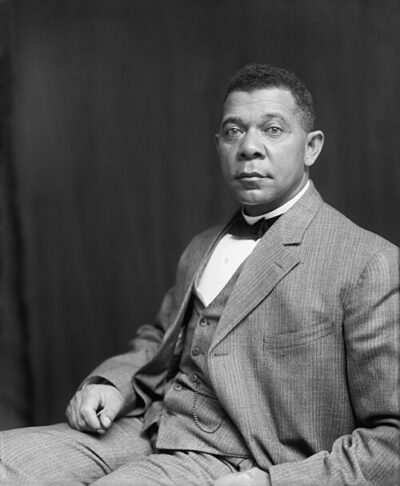
Booker T. Washington
Booker T. Washington was an African-American educator, author, orator, and advisor. Born April 5, 1856, in Hale's Ford. Died November 14, 1915, in Tuskegee. Positions held include civil rights advocate, president (1888–1891) and head teacher. Educated at Hampton University.
Facts
33 facts · 2 confirmed by two sources · 11 cited · 20 from one source
Where this comes from
Papalocal keeps its own record. It started from these sources; what each one said is kept here as it was copied, so a change on their side never changes this page by itself. Tap one to read its version.
What Wikidata says · copied November 13, 2026 · revision 2562999850
- Described as
- African-American educator, author, orator, and advisor (1856-1915)
- Other names
- Booker Washington, Booker Taliaferro Washington
- Born
- April 5, 1856 · 8 references
- Died
- November 14, 1915 · 10 references
- Born in
- Hale's Ford · 2 references
- Died in
- Tuskegee · 2 references
- Buried in
- Tuskegee University Campus Cemetery · 1 reference
- Cause of death
- cardiovascular disease
- Name at birth
- Booker Taliaferro Washington
- Citizen of
- United States · 1 reference
- Occupation
- educator; writer · 2 references; autobiographer; pedagogue · 1 reference; businessperson; politician · 3 references; human rights defender · 1 reference; teacher · 1 reference
- Positions held
- civil rights advocate; president (1888–1891) · 1 reference; head teacher · 1 reference
- Political party
- Republican Party
- Worked for
- Tuskegee University
- Education
- Hampton University
- Member of
- National Negro Business League; Alabama State Teachers Association · 1 reference
- Spouse
- Fannie Smith Washington (1882–1884); Olivia A. Davidson (1886–1889); Margaret Murray Washington (1893–1915)
- Children
- Booker T. Washington, Jr. · 1 reference; Portia Washington Pittman; Ernest Davidson Washington
- Mother
- Nataly Anette
- Siblings
- John Henry Washington; Amanda Washington
- Wikipedias with a page
- 64
Wikidata item Q319871 (wikidata.org/wiki/Q319871), public domain (CC0). Copied November 13, 2026.
What Wikipedia says · copied November 13, 2026 · revision 1385109632
Booker Taliaferro Washington (April 5, 1856 – November 14, 1915) was an American educator, author, and orator. Between 1890 and 1915, Washington was the primary leader in the African-American community and of the contemporary Black elite.
Born into slavery on April 5, 1856, in Hale's Ford, Virginia, Washington was freed when U.S. troops reached the area during the Civil War. As a young man, he worked his way through Hampton Normal and Agricultural Institute and attended college at Wayland Seminary. In 1881, he was named as the first leader of the new Tuskegee Institute in Alabama, an institute for black higher education. He expanded the college, enlisting students in construction of buildings. Work at the college was considered fundamental to students' larger education. He attained national prominence for his Atlanta Address of 1895, which attracted the attention of politicians and the public. Washington played a dominant role in black politics, winning wide support in the black community of the South and among more liberal whites. Washington wrote an autobiography, Up from Slavery, in 1901, which became a major text. In that year, he dined with Theodore Roosevelt at the White House. After an illness, he died in Tuskegee, Alabama, on November 14, 1915.
Washington was a key proponent of African-American businesses and one of the founders of the National Negro Business League. Washington mobilized a nationwide coalition of middle-class Black people, church leaders, and white philanthropists and politicians, with the goal of building the community's economic strength and pride by focusing on self-help and education. Washington had the ear of the powerful in the United States of his day, including presidents. He used the nineteenth-century American political system to manipulate the media, raise money, develop strategy, network, distribute funds, and reward a cadre of supporters. Because of his influential leadership, the timespan of his activity, from 1880 to 1915, has been called the Age of Booker T. Washington. Washington called for Black progress through education and entrepreneurship, rather than trying to challenge directly the Jim Crow segregation and the disenfranchisement of Black voters in the South. Furthermore, he supported racial uplift, but secretly also supported court challenges to segregation and to restrictions on voter registration. Black activists in the North, led by W. E. B. Du Bois, disagreed with him and opted to set up the NAACP to work for political change.
After his death in 1915, he came under heavy criticism for accommodating white supremacy, despite his claims that his long-term goal was to end the disenfranchisement of African Americans, the vast majority of whom still lived in the South. Decades after Washington's death in 1915, the civil rights movement of the 1950s took a more active and progressive approach, which was also based on new grassroots organizations based in the South. Washington's legacy has been controversial in the civil rights community. However, in the late twentieth century, more nuanced perspectives about his actions by scholars and historians interpreted him more positively.
- Born, in its opening lines
- April 5, 1856
- Died, in its opening lines
- November 14, 1915
From the Wikipedia article “Booker T. Washington” (en.wikipedia.org/wiki/Booker_T._Washington), by its contributors, under CC BY-SA 4.0 (creativecommons.org/licenses/by-sa/4.0/). Copied November 13, 2026; not changed.
Confirmed Two sources agree. Cited One source, and it names where it got it. One source One source, without a reference of its own. Sources disagree The sources disagree. We show the best-supported value and keep theirs below.
