
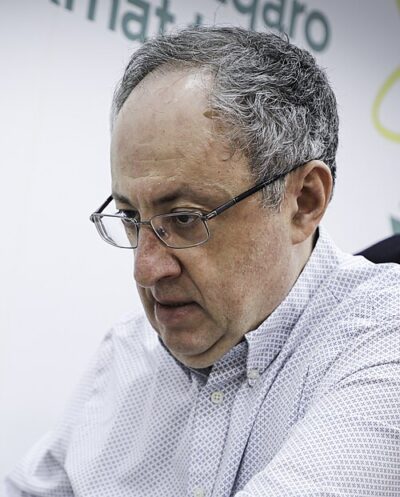
Boris Gelfand is a Belarusian-Israeli chess player. Born June 24, 1968, in Minsk. Awards include Order of Friendship.
Facts
11 facts · 1 confirmed by two sources · 4 cited · 6 from one source
Where this comes from
Papalocal keeps its own record. It started from these sources; what each one said is kept here as it was copied, so a change on their side never changes this page by itself. Tap one to read its version.
What Wikidata says · copied November 16, 2026 · revision 2560026218
- Described as
- Belarusian-Israeli chess player
- Born
- June 24, 1968
- Born in
- Minsk · 1 reference
- Citizen of
- Israel; Soviet Union; Belarus
- Occupation
- chess player; non-fiction writer
- Sport
- chess · 1 reference
- Awards
- Order of Friendship
- Spouse
- Maya Gelfand · 1 reference
- Lived in
- Rishon LeZion · 1 reference
- Wikipedias with a page
- 52
Wikidata item Q486778 (wikidata.org/wiki/Q486778), public domain (CC0). Copied November 16, 2026.
What Wikipedia says · copied November 16, 2026 · revision 1363390864
Boris Abramovich Gelfand (born 24 June 1968) is a Belarusian and Israeli chess grandmaster.
A six-time World Championship candidate (1991, 1994–95, 2002, 2007, 2011, 2013), he won the Chess World Cup 2009 and the 2011 Candidates Tournament, making him challenger for the World Chess Championship 2012. Although the match with defending champion Viswanathan Anand finished level at 6–6, Gelfand lost the deciding rapidplay tiebreak by 2½–1½.
Gelfand has won major tournaments at Wijk aan Zee, Tilburg, Moscow, Linares and Dos Hermanas. He has competed in eleven Chess Olympiads and held a place within the top 30 players ranked by FIDE from January 1990 to October 2017.
- Born, in its opening lines
- June 24, 1968
From the Wikipedia article “Boris Gelfand” (en.wikipedia.org/wiki/Boris_Gelfand), by its contributors, under CC BY-SA 4.0 (creativecommons.org/licenses/by-sa/4.0/). Copied November 16, 2026; not changed.
Confirmed Two sources agree. Cited One source, and it names where it got it. One source One source, without a reference of its own. Sources disagree The sources disagree. We show the best-supported value and keep theirs below.
