
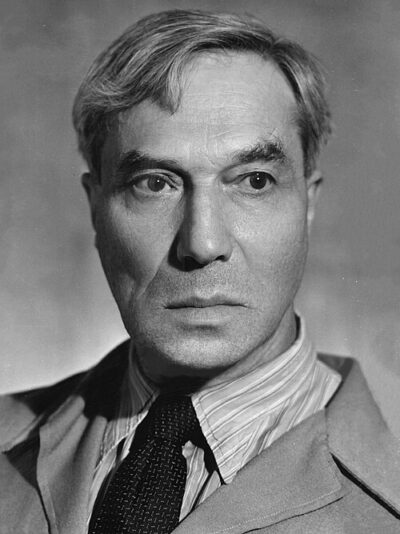
Boris Pasternak
Boris Pasternak was a Russian writer. Born January 29, 1890, in Moscow. Died May 30, 1960, in Peredelkino. Known for Doctor Zhivago. Educated at Moscow State University, Faculty of Law and University of Marburg. Awards include Nobel Prize in Literature, Medal "For the Defence of Moscow" and Medal "For Valiant Labour in the Great Patriotic War 1941–1945".
Facts
37 facts · 1 confirmed by two sources · 8 cited · 27 from one source · 1 where the sources disagree
What’s different
- Born: we show January 29, 1890 (Sources disagree). Wikipedia says February 10, 1890
Where this comes from
Papalocal keeps its own record. It started from these sources; what each one said is kept here as it was copied, so a change on their side never changes this page by itself. Tap one to read its version.
What Wikidata says · copied November 16, 2026 · revision 2568575975
- Described as
- Russian writer (1890–1960)
- Other names
- Boris Leonidovich Pasternak
- Born
- January 29, 1890 · 1 reference
- Died
- May 30, 1960 · 14 references
- Born in
- Moscow · 2 references
- Died in
- Peredelkino · 1 reference
- Buried in
- Peredelkino Cemetery · 1 reference
- Cause of death
- lung cancer
- Name at birth
- Борис Исаакович Постернак · 1 reference
- Citizen of
- Russian Empire; Soviet Union
- Occupation
- writer · 2 references; poet · 1 reference; translator · 2 references; novelist; playwright; pianist; prose writer · 1 reference; translator of William Shakespeare
- Education
- Moscow State University, Faculty of Law (1908–); University of Marburg (1912) · 1 reference; Lomonosov Moscow State University (–1913) · 1 reference; Imperial Moscow University (–1912) · 1 reference
- Instrument
- piano
- Known for
- Doctor Zhivago · 1 reference
- Awards
- Nobel Prize in Literature (1958) · 2 references; Medal "For the Defence of Moscow"; Medal "For Valiant Labour in the Great Patriotic War 1941–1945"; Bancarella Literary Prize (1958) · 1 reference
- Field
- prose · 1 reference
- Spouse
- Zinaida Nikolajevna Pasternak (1932–1960) · 1 reference; Evgenia Lurie (1922–1931)
- Children
- Yevgeny Pasternak · 1 reference
- Father
- Leonid Pasternak · 1 reference
- Mother
- Rosa Kaufman
- Siblings
- Alexander Pasternak; Josephine Pasternak; Lydia Pasternak Slater · 1 reference
- Religion
- Eastern Orthodoxy
- Wikipedias with a page
- 143
Wikidata item Q41223 (wikidata.org/wiki/Q41223), public domain (CC0). Copied November 16, 2026.
What Wikipedia says · copied November 16, 2026 · revision 1383616260
Boris Leonidovich Pasternak (10 February [O.S. 29 January] 1890 – 30 May 1960) was a Russian and Soviet poet, novelist, and literary translator.
Composed in 1917, Pasternak's first book of poems, My Sister, Life, was published in Berlin in 1922 and soon became an important collection in the Russian language. Pasternak's translations of plays by Goethe, Schiller, Calderón de la Barca and Shakespeare remain very popular within Russian theatre scholarship.
Pasternak is the author of Doctor Zhivago (1957), a novel that takes place between the Russian Revolution of 1905 and the Second World War. Doctor Zhivago was rejected for publication in the USSR, but the manuscript was smuggled to Italy and was first published there in 1957, as part of a CIA operation to undermine the Soviet Union in the eyes of its citizens.
Pasternak was awarded the 1958 Nobel Prize in Literature, an event that enraged the Communist Party of the Soviet Union, which forced him to decline the prize. In 1989, Pasternak's son Yevgeny finally accepted the award on his father's behalf. Doctor Zhivago has been part of the main Russian school curriculum since 2003.
- Born, in its opening lines
- February 10, 1890
- Died, in its opening lines
- May 30, 1960
From the Wikipedia article “Boris Pasternak” (en.wikipedia.org/wiki/Boris_Pasternak), by its contributors, under CC BY-SA 4.0 (creativecommons.org/licenses/by-sa/4.0/). Copied November 16, 2026; not changed.
Confirmed Two sources agree. Cited One source, and it names where it got it. One source One source, without a reference of its own. Sources disagree The sources disagree. We show the best-supported value and keep theirs below.
