
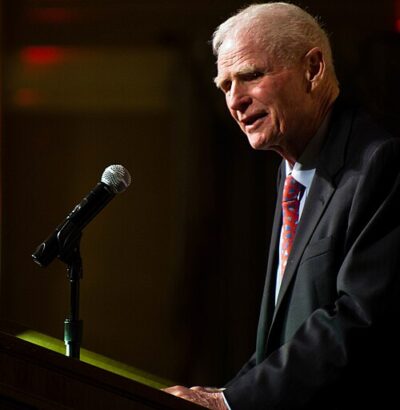
Brendan Byrne
Brendan Byrne was an American politician and prosecutor. Born April 1, 1924, in West Orange. Died January 4, 2018, in Livingston. Positions held include Governor of New Jersey (1974–1982). Educated at Princeton School of Public and International Affairs and Princeton University. Awards include Distinguished Flying Cross, Air Medal and New Jersey Hall of Fame.
Facts
25 facts · 2 confirmed by two sources · 7 cited · 16 from one source
Where this comes from
Papalocal keeps its own record. It started from these sources; what each one said is kept here as it was copied, so a change on their side never changes this page by itself. Tap one to read its version.
What Wikidata says · copied November 18, 2026 · revision 2519180776
- Described as
- American politician and prosecutor (1924-2018)
- Other names
- Brendan Thomas Byrne
- Born
- April 1, 1924 · 1 reference
- Died
- January 4, 2018 · 2 references
- Born in
- West Orange
- Died in
- Livingston
- Buried in
- Princeton Cemetery · 1 reference
- Cause of death
- infectious disease
- Citizen of
- United States
- Occupation
- lawyer · 1 reference; judge; politician · 1 reference; governor · 1 reference; jurist · 1 reference; prosecutor · 1 reference
- Positions held
- Governor of New Jersey (1974–1982)
- Political party
- Democratic Party
- Education
- Princeton School of Public and International Affairs; Princeton University; Harvard Law School; Seton Hall University; West Orange High School · 1 reference
- Awards
- Distinguished Flying Cross; Air Medal; New Jersey Hall of Fame (2011) · 1 reference
- Spouse
- Jean Byrne (1953–)
- Military rank
- first lieutenant · 1 reference
- Wikipedias with a page
- 15
Wikidata item Q888937 (wikidata.org/wiki/Q888937), public domain (CC0). Copied November 18, 2026.
What Wikipedia says · copied November 18, 2026 · revision 1364543345
Brendan Thomas Byrne (April 1, 1924 – January 4, 2018) was an American attorney and Democratic Party politician who served as the 47th Governor of New Jersey from 1974 to 1982.
Byrne began his career as a private attorney in Newark and East Orange. In 1959, Governor Robert B. Meyner appointed Byrne to serve as Essex County Prosecutor; he served in that role until 1968. In the late 1960s, an FBI wiretap recorded local mobsters calling Byrne "the man who couldn't be bought" in reference to his high ethical standards. The publication of the comment propelled Byrne to popularity in an era when corruption was a major concern in state and national politics. He left his office as prosecutor to serve as President of the New Jersey Board of Public Utilities from 1968 to 1970, then as a Superior Court judge.
In 1973, using "the man who couldn't be bought" as a campaign slogan, Byrne ran for governor of New Jersey. He won the Democratic primary with support from the powerful Hudson County political machine and carried the general election. His landslide victory, until then the largest in the state's history, was seen as a reaction against a bribery scandal in state government and the Watergate scandal.
During his first term, Byrne signed the state's first income tax, which broke a campaign promise and was initially highly unpopular across party lines. In 1977, he faced several prominent challengers for the party nomination but won the Democratic primary with a small plurality of the vote. Despite expectations he would lose the general election to Raymond Bateman, Byrne came from behind to win a second term.
During his time as governor, Byrne oversaw the opening of the first gambling casinos in Atlantic City and established the New Jersey Department of the Public Advocate. He also preserved a large majority of woodlands and wildlife areas in the state by restricting development.
- Born, in its opening lines
- April 1, 1924
- Died, in its opening lines
- January 4, 2018
From the Wikipedia article “Brendan Byrne” (en.wikipedia.org/wiki/Brendan_Byrne), by its contributors, under CC BY-SA 4.0 (creativecommons.org/licenses/by-sa/4.0/). Copied November 18, 2026; not changed.
Confirmed Two sources agree. Cited One source, and it names where it got it. One source One source, without a reference of its own. Sources disagree The sources disagree. We show the best-supported value and keep theirs below.
